Compliance
Why EV Two-Wheeler Financing Is Struggling in India
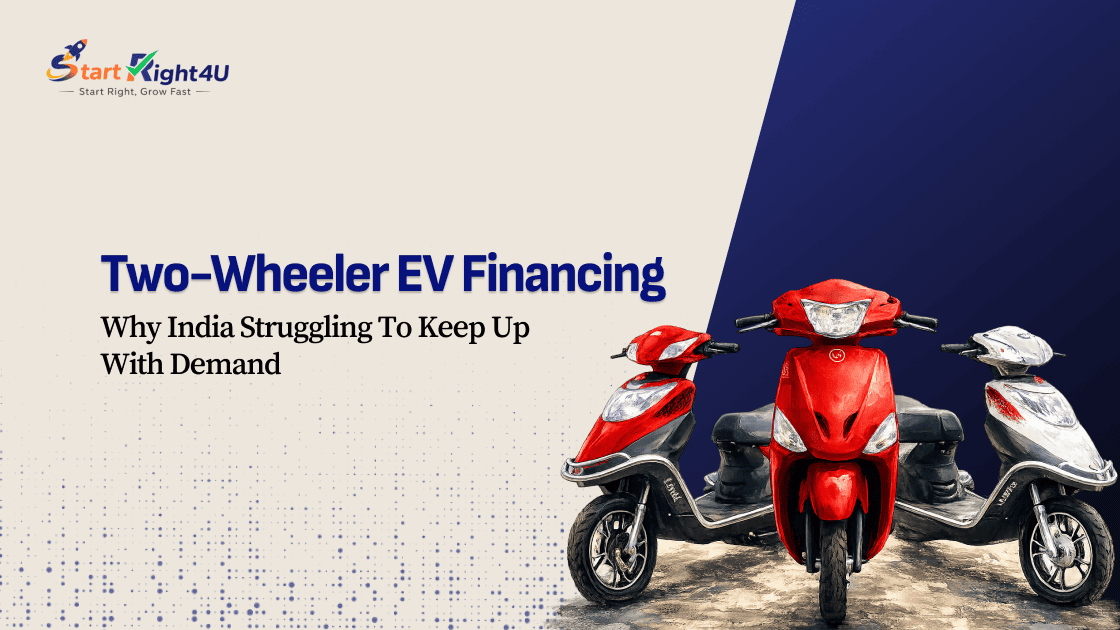
India's electric two-wheeler story has quietly become one of the most remarkable shifts in the country's automobile history. Electric scooters and bikes that were once a curiosity on city roads are now a common sight outside metro stations, college gates, and delivery hubs in even tier-2 and tier-3 towns. Electric two-wheeler registrations crossed 1.40 million units in FY26, growing more than 21% over the previous year and now making up close to 6.5% of total two-wheeler sales nationwide, up from 5.8% a year earlier. Globally, the electric two-wheeler segment alone accounted for nearly 58% of all EV sales in India during this period, confirming that the two-wheeler is, by far, the most important vehicle category in the country's EV transition.
Yet beneath this growth story lies a quieter, more complicated narrative: financing has not kept pace with demand. While millions of Indians are mentally ready to switch from petrol to electric, a meaningful share of them are stuck at the financing stage, either because loans are harder to get, more expensive than they should be, or simply unavailable in the towns where demand is rising fastest. This article unpacks why a two-wheeler EV loan in India has become both a growth engine and a bottleneck, why electric scooter financing NBFC institutions are central to solving this puzzle, and what borrowers, dealers, and lenders need to understand about this fast-changing market.
How Big Is the Demand for Electric Two-Wheelers in India Right Now?
The numbers tell a story of accelerating, broad-based demand rather than a niche trend confined to metro early adopters. India's electric two-wheeler market is now valued in the tens of billions of dollars globally and is expected to more than double by the early 2030s as battery costs fall and charging infrastructure expands. Within India specifically, electric two-wheelers grew from under 950,000 units in FY24 to over 1.15 million in FY25, and then to 1.40 million units in FY26; a trajectory that shows compounding, not one-off, growth.
What is particularly telling is who is now selling these vehicles. For the first few years of the EV two-wheeler boom, newer brands such as Ola Electric and Ather dominated headlines and sales charts. That has changed. Traditional manufacturers with decades of dealer networks and after-sales trust — TVS Motor, Bajaj Auto, and Hero MotoCorp; now control more than half of the electric two-wheeler market, with TVS alone registering over 340,000 units in FY26, a 43% jump from the previous year. This shift matters enormously for financing, because established OEMs bring stronger resale value, predictable after-sales service, and dealer-level financing tie-ups, all of which directly affect how comfortable a lender feels approving a loan.
The growth is no longer being driven purely by subsidies either. Government support under the FAME scheme and its successor, the PM E-DRIVE scheme, has played a critical role in bringing prices down, but industry voices now describe the market as entering a more mature, demand-led phase. Even as two-wheeler subsidies under PM E-DRIVE are set to wind down around July 2026, manufacturers say production scale and falling battery costs mean the segment can sustain momentum on its own. This is precisely the moment when financing access — not subsidies; becomes the deciding factor in whether this growth curve continues or flattens.
Why Does Demand for EV Two-Wheelers Keep Rising Despite Higher Upfront Costs?
A few structural forces are converging to push more Indian households and gig workers toward electric scooters and bikes. The most obvious is running cost. An electric scooter typically costs a fraction of what a petrol scooter costs to run per kilometre, and with fuel prices remaining a persistent household expense, the total cost of ownership argument for EVs has become increasingly hard to ignore — especially for high-mileage riders such as food delivery and e-commerce logistics workers who may ride 80–150 km a day.
Battery prices have also fallen sharply, from around $137 per kWh in 2024 toward a projected $89 per kWh by 2030, and because batteries can account for up to 40% of the on-road cost of a two-wheeler, this single trend is doing more to make EVs affordable than almost any other factor. Combined with localisation under India's Production-Linked Incentive scheme, this is steadily narrowing the price gap between electric and petrol scooters, particularly in the entry-level and commuter segments where most Indian buyers actually shop.
Infrastructure has matured too. Charging networks have expanded well beyond major metros, range anxiety has eased as battery technology has improved, and a wider range of models across price points means a buyer in a smaller town now has real choices rather than one or two premium options. Add to this the steady stream of new product launches from established brands with strong service networks, and you get a buyer base that is larger, more diverse by income level, and more geographically spread than it was even two years ago. This diversity is exactly why financing has become the constraint — because a gig worker in Indore or a college student in Coimbatore does not have the same access to formal credit as a salaried professional in Bengaluru, even though both want the same electric scooter.
Why Is There a Financing Gap for Electric Two-Wheelers Even as Sales Surge?
This is the central tension in the market. India's electric vehicle financing market itself is growing extremely fast; estimated at around USD 2.37 billion in 2025 and projected to reach roughly USD 3.59 billion in 2026, with some projections suggesting it could expand to nearly USD 29 billion by 2031 at a compound annual growth rate above 50%. Two-wheelers currently account for the largest share of this financing market, close to 46% of total EV financing value. On paper, this looks like a financing boom. In practice, the experience for an individual buyer is often very different.
Industry research conducted with the Electric Mobility Financiers Association of India, a consortium of roughly 35 of India's leading NBFCs, identified the steep cost of borrowing as the single biggest obstacle financiers themselves face. Because lenders see EVs as a newer, less-proven asset class — with uncertain resale values, evolving battery technology, and limited historical default data compared to petrol vehicles — they price in a risk premium. The practical result is that electric two-wheeler loan terms run roughly 5–14% costlier than loans for equivalent petrol vehicles, even though the EV itself may be cheaper to run and, increasingly, cheaper to buy.
There is also a borrower-side gap that rarely gets discussed: financial literacy and digital comfort. Lenders working closely with EV buyers, particularly first-time borrowers and gig economy workers, have observed a genuine gap in understanding of EV products, battery maintenance, and digital repayment systems. This unfamiliarity, rather than any real unwillingness to repay, has translated into a higher default rate among EV borrowers compared to traditional two-wheeler borrowers. In other words, a meaningful part of the "EV lending gap" isn't about creditworthiness in the traditional sense — it's about a financing ecosystem that hasn't yet built the right tools, education, and risk models for an entirely new category of vehicle and borrower.
Geography compounds the problem. Much of the freshest EV demand is now coming from semi-urban and rural markets, exactly the areas where formal banking penetration is thinnest and where NBFCs — not large banks — do most of the heavy lifting. Many of these borrowers are new to credit, lack a long credit history, and may not have conventional salary slips, even though they have stable, provable income from gig work, small trades, or seasonal businesses. Until lenders build better tools to assess this kind of income, a large pool of genuinely creditworthy buyers will keep falling through the cracks.
What Interest Rates and Loan Terms Can You Expect on a Two Wheeler EV Loan in India?
Pricing on electric two-wheeler loans varies more widely than most buyers expect, and understanding this range is the first step to negotiating a fair deal. As of 2026, interest rates on electric two-wheeler loans broadly span from around 14.5% to as high as 31% per annum, depending heavily on the lender, the buyer's credit profile, and the vehicle brand. By comparison, equivalent petrol two-wheeler loans tend to range between roughly 16% and 20%, although some lenders advertise rates as low as single digits for top-tier, low-risk borrowers under promotional schemes. This is the practical face of the "EV risk premium" discussed earlier — the same applicant, buying an electric instead of a petrol scooter, may see a noticeably higher quoted rate from certain lenders.
Loan-to-value ratios are generally generous on paper. Several large banks and NBFCs advertise financing of 90% to 100% of the on-road price, meaning a buyer can, in theory, walk away with little to no down payment. In reality, a zero-down-payment loan increases the principal significantly and can add 15–25% more to the total interest paid over the loan's life compared to putting down even a modest 15–20% upfront. Lenders also use a down payment as a signal of financial discipline, and buyers who put money down often unlock better rates meaningfully as a result.
Tenures typically run from one to five years, with most electric two-wheeler loans clustering around two to four years given the relatively modest loan amounts involved — usually somewhere between ₹80,000 and ₹1.5 lakh for retail buyers. Processing fees differ sharply by lender type: some larger NBFCs and banks waive fees for well-qualified applicants, while others charge anywhere from 1% to 2% of the loan amount. A credit score above 750 remains the single most reliable lever for securing a lower rate, though NBFCs are typically far more flexible than banks, often approving applicants with scores in the 600s or with thin credit files, which is precisely why NBFCs dominate this segment.
It's also worth knowing that government support can meaningfully reduce the real cost of an EV loan. Individuals purchasing an EV for personal use can claim a deduction of up to ₹1.5 lakh on loan interest paid under Section 80EEB of the Income Tax Act, and several states — including Delhi, Maharashtra, Gujarat, and Tamil Nadu — layer on additional subsidies that reduce the purchase price itself, indirectly lowering the loan principal a buyer needs to borrow in the first place.
Why Have NBFCs Become the Backbone of Electric Scooter Financing in India?
If there is one institution type that has made EV two-wheeler ownership possible for the average Indian buyer, it is the NBFC. Banks remain selective, often requiring strong salaried income, established credit history, and extensive documentation — criteria that simply exclude large parts of India's EV-buying population, including gig workers, small traders, students, and first-time earners. NBFCs, by contrast, have built their entire lending model around exactly this underserved segment.
NBFCs and captive finance arms tied to manufacturers — names like Bajaj Finance, Hero FinCorp, TVS Credit, and a newer wave of EV-focused lenders such as Manba Finance, Mufin Green Finance, Revfin, and Embifi — have emerged as the primary providers of organised, formal credit to e-2W and e-3W buyers. Their advantage lies in three things traditional banks struggle to replicate at scale: speed, flexibility, and last-mile reach. A buyer at a dealership can often walk away with loan approval in 30 minutes to two hours through an NBFC, compared to same-day-to-a-week timelines at most banks. NBFCs are also far more willing to underwrite "thin file" customers — people with little or no formal credit history — using alternative signals like bank transaction patterns, gig-platform earnings data, and dealer references instead of relying solely on a CIBIL score.
This is not a small or peripheral role; it is the backbone of the entire EV two-wheeler financing ecosystem. NBFCs have direct, relationship-based interactions with borrowers that large banks simply do not have the branch density or risk appetite to replicate, particularly in tier-2 and tier-3 towns where so much of the current EV demand surge is concentrated. Recognising this, policy bodies including NITI Aayog have recommended that EV lending by banks and NBFCs be formally classified under the Reserve Bank of India's priority-sector lending guidelines — a move that would unlock cheaper capital for NBFCs and, in turn, more affordable loans for end borrowers. Some states have already moved in this direction at the margin, with programmes like Maharashtra's per-kWh battery subsidy effectively shaving 200–300 basis points off the real cost of borrowing for eligible buyers.
Despite all of this, NBFCs themselves face a structural disadvantage: their own cost of borrowing is higher than that of banks, since they typically raise funds from banks and capital markets rather than low-cost retail deposits. This is exactly why concessional capital — from institutions like SIDBI, multilateral development banks, and philanthropic risk-sharing facilities such as the Shell Foundation's risk-sharing arrangement with SIDBI — has become so important. These instruments effectively absorb a portion of the losses NBFCs might face on EV loans, allowing them to lend more freely and at better rates to genuinely creditworthy but underserved borrowers.
Who Is Actually Struggling to Get an EV Two-Wheeler Loan Approved?
It's worth being specific about who falls into this "lending gap," because the answer isn't simply "people with bad credit." Three borrower groups consistently face the most friction. The first is gig and platform workers — delivery riders, cab drivers, and last-mile logistics partners — who often have strong, provable monthly income through digital payment trails but lack a traditional salary slip or long credit history, making them harder to assess using conventional bank underwriting models, even though this exact group represents some of the highest-utility, lowest-risk EV buyers given how much they ride and how directly an EV reduces their daily fuel cost.
The second group is first-time borrowers in semi-urban and rural India, where bank branch density is low, financial literacy around digital repayment is still developing, and formal credit history is often nonexistent. These buyers are precisely where most of FY26's incremental EV demand has come from, yet they are also where the "5–14% costlier than petrol loans" gap tends to bite hardest, because lenders price in extra risk for both the unfamiliar asset class and the unfamiliar borrower profile simultaneously.
The third group, somewhat counterintuitively, is buyers of newer or less-established EV brands. Because resale value and brand pedigree weigh heavily in a lender's risk assessment, someone buying from a well-established OEM with deep dealer and service networks will typically get faster approval and better terms than someone buying an equally good vehicle from a newer or smaller manufacturer with a thinner track record — even if the underlying vehicle quality is comparable. This dynamic is part of why established manufacturers have been steadily gaining EV two-wheeler market share: their vehicles are simply easier to finance.
How Can Buyers Improve Their Chances of Getting a Better EV Loan Deal?
A few practical, well-documented levers consistently make a difference. Maintaining a credit score above 750 remains the single most powerful factor in securing a lower interest rate, and even buyers with thinner credit files can improve their standing by ensuring existing obligations — credit cards, prior loans, even utility bill payments where reported — are paid on time in the months leading up to a loan application. Choosing a shorter tenure where affordable also helps, since longer tenures typically carry both higher total interest and, in many cases, a higher quoted rate.
Putting down even a modest down payment of 15–20%, rather than opting for a zero-down-payment scheme, reduces the loan principal, often unlocks a better rate, and meaningfully lowers total interest paid over the loan term — sometimes by several thousand rupees on an otherwise identical loan. Buyers should also actively compare offers across both banks and NBFCs rather than accepting the first financing option presented at the dealership; processing fees, foreclosure charges, and the difference between flat-rate and reducing-balance interest calculations can change the real cost of a loan substantially even when the headline interest rate looks similar.
Finally, it's worth checking whether the specific vehicle and state qualify for any active subsidy whether under the PM E-DRIVE scheme, a state-level EV policy, or the Section 80EEB tax deduction on loan interest; since these benefits can be stacked with a loan to materially reduce the real, after-tax cost of ownership. Many manufacturers also run their own subsidised or 0% EMI schemes in partnership with NBFCs at the dealership level, which are worth asking about directly rather than assuming the standard lender rate is the only option.
What Needs to Happen to Close India's EV Two-Wheeler Financing Gap?
The path forward is reasonably well understood by industry participants, even if execution is still catching up. Digitalisation of the lending process — instant KYC, alternative-data underwriting, and paperless disbursal — is widely seen as the single most powerful tool for expanding access in rural and semi-urban markets, where physical branch infrastructure will likely never catch up to demand. Several NBFCs and fintech lenders have already begun compressing approval timelines from days to minutes using AI-driven underwriting models that look beyond a traditional CIBIL score.
Concessional and blended-finance capital also has an outsized role to play. By lowering NBFCs' own cost of borrowing through instruments like partial risk-sharing guarantees and concessional loans, institutions such as SIDBI and philanthropic capital providers can directly translate into lower, fairer interest rates for end consumers — addressing the 5–14% EV cost premium at its root rather than asking individual borrowers to simply absorb it. Formal recognition of EV lending under RBI's priority-sector lending norms, something policy bodies have actively recommended, would extend this benefit system-wide.
There is also a genuine opportunity in borrower education. Because a meaningful share of EV loan defaults stems from unfamiliarity with battery maintenance and digital repayment systems rather than unwillingness to pay, simple, well-designed financial literacy efforts — at the point of sale, in the local language, focused on EMI discipline and basic vehicle upkeep — could measurably reduce delinquency and, over time, justify lower risk premiums on EV loans altogether. Combined with continued growth in last-mile delivery fleet electrification, which gives lenders rich usage data to build smarter, usage-linked repayment products, the building blocks for closing this gap are largely in place. What remains is execution, speed, and getting the right financing option in front of the right buyer at the right moment — often at the exact point of sale, when the decision to switch to electric is being made.
Finding the Right EV Financing Partner Without the Guesswork
For most buyers, the hardest part of going electric isn't deciding whether an EV makes sense — the fuel savings, lower maintenance, and growing model choice usually make that case on their own. The hard part is navigating dozens of bank and NBFC offers, each with different eligibility rules, processing fees, and fine print, and figuring out which one will actually approve your application without quietly charging you a premium for being an EV buyer or a first-time borrower.
This is the kind of friction StartRight4U exists to remove. Rather than sending every customer to a single lender's standard offer, the team works across a network of banks and NBFC partners to match a buyer's specific profile — whether that's a salaried professional, a gig worker with digital income proof, or a first-time borrower in a smaller town — with lenders genuinely suited to approve and price that profile fairly. For someone weighing a two wheeler EV loan India decision, or trying to understand which electric scooter financing NBFC option fits their situation best, having someone compare the real terms across multiple lenders, flag hidden charges, and handle the documentation can be the difference between a smooth approval and weeks of back-and-forth. If you're somewhere in the process of choosing your electric scooter or bike and want a second opinion on financing before you sign anything, that's a conversation worth having before you walk into a dealership.