
Compliance
EV Manufacturing Unit Setup in India
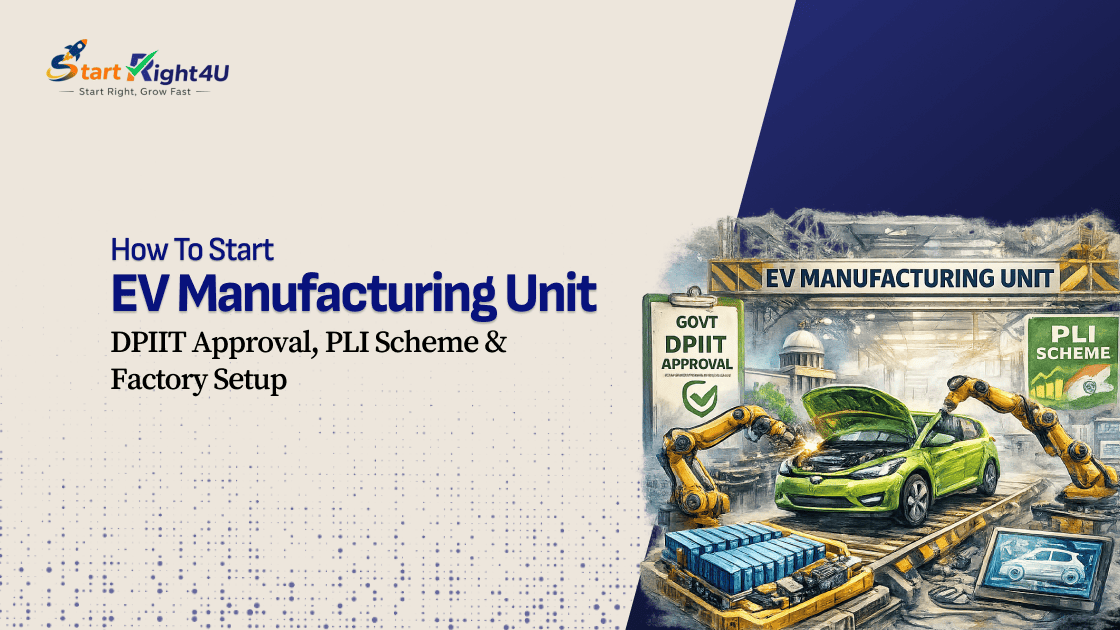
India's electric vehicle manufacturing story has entered a phase where policy paperwork matters just as much as engineering talent. With EV sales crossing 25 lakh units in FY2025-26 and penetration climbing toward 8.5% of total vehicle registrations, the demand side of the equation is no longer in question. What separates a founder who actually gets a plant running from one who spends two years stuck in approval limbo is whether they understand the regulatory sequence correctly — DPIIT recognition, PLI-Auto eligibility, land and environmental clearances, homologation through ARAI or ICAT, and the dozen smaller licences that sit between a business plan and a functioning assembly line. This guide walks through that sequence in the order a founder or investor would realistically encounter it, using the current 2026 framework rather than outdated pre-PLI guidance that still circulates online.
What Exactly Counts as "EV Manufacturing" in India, and Why Does the Category You Choose Matter?
Before a single application is filed, the first decision a founder has to make is which layer of the EV manufacturing stack they are actually entering, because the licensing burden, capital requirement, and government incentive eligibility change dramatically depending on the answer. Full vehicle manufacturing — assembling complete electric two-wheelers, three-wheelers, or passenger cars — sits at one end of the spectrum, requiring vehicle-level homologation, full factory certification, and typically ₹1,000-5,000 crore of capital for a four-wheeler plant, though two- and three-wheeler assembly units can be started at a fraction of that. Component manufacturing — producing motor controllers, battery management systems, on-board chargers, or wiring harnesses that feed into OEM supply chains — sits at the other end, with component plants often becoming operational for as little as ₹50-95 lakh to a few crore, and a typical timeline of 9-14 months from company registration to first bulk dispatch. Battery and Advanced Chemistry Cell manufacturing occupies its own separate track entirely, governed by a distinct PLI scheme (PLI-ACC) with its own eligibility rules.
This distinction matters because most first-time entrepreneurs researching "how to start an EV manufacturing unit" picture a full vehicle assembly line, when in reality the fastest, most capital-efficient, and most immediately profitable entry point for a new player is almost always the component or sub-assembly layer — precisely because India still imports roughly 94% of the sophisticated power electronics that go into locally assembled EVs. Deciding this early shapes every downstream approval because a component manufacturer's DPIIT, factory licence, and BIS certification pathway is considerably shorter than a full vehicle OEM's.
How Do You Register the Business and Get DPIIT Recognition Before Manufacturing Begins?
Every EV manufacturing venture, regardless of scale, starts with formal business registration — almost always as a Private Limited Company, since this structure allows full foreign ownership where relevant, limited liability protection, and access to external commercial borrowing for capital expenditure, none of which a proprietorship or partnership can offer at scale. Once incorporated, the next logical step — and one that a surprising number of founders skip or delay unnecessarily — is DPIIT (Department for Promotion of Industry and Internal Trade) Startup Recognition, applied for entirely online through the Startup India portal, with recognition typically granted within about 72 hours of a complete application.
DPIIT recognition is not mandatory to manufacture EVs, but skipping it is effectively leaving money on the table, because a recognised startup under 10 years old (or up to 20 years for the newly introduced Deep Tech category, which many EV component businesses now qualify under) becomes eligible for a three-year income tax holiday under Section 80-IAC, angel tax exemption on investor funding, self-certification under labour and environmental laws for the first few years, and priority access to government tenders and procurement — all of which materially ease the cash-flow pressure of the capital-intensive setup phase. Founders should treat DPIIT recognition as a parallel-track activity that runs alongside company incorporation, not something to be revisited later once the factory is already under construction, since several of its benefits — particularly the 80-IAC tax holiday, which requires separate Inter-Ministerial Board approval — take additional processing time and are far easier to secure before the business starts generating taxable profit.
What Is the PLI Scheme for Automobiles, and Who Actually Qualifies for It?
The Production Linked Incentive Scheme for Automobile and Auto Components is the single most consequential piece of financial support available to an EV manufacturer in India today, and understanding its structure properly is essential before assuming eligibility. Approved by the Union Cabinet in September 2021 with a total outlay of ₹25,938 crore running from FY2022-23 through FY2026-27, the scheme is built specifically around Zero Emission Vehicles — Battery Electric Vehicles and Hydrogen Fuel Cell Vehicles — and is structured into two distinct tracks that founders frequently confuse.
The Champion OEM Incentive Scheme is a sales-value-linked incentive aimed at large vehicle manufacturers, requiring an existing automotive company (or its group companies) to meet substantial revenue and investment thresholds, while a New Non-Automotive Investor Company — meaning a business or investor group with no prior presence in vehicle manufacturing — must instead demonstrate a global net worth of at least ₹1,000 crore to qualify under this track. This route is realistically accessible only to large corporate groups or well-funded new entrants making a serious capital commitment, not early-stage startups. The Component Champion Incentive Scheme, by contrast, is far more accessible to mid-sized and emerging players, covering 103 notified Advanced Automotive Technology components — including EV-specific parts like charging ports, e-drivetrains, e-compressors, and electric vacuum pumps — with incentive slabs that reward incremental sales over the FY2019-20 base year.
Both tracks share one non-negotiable condition that trips up many applicants: a minimum Domestic Value Addition of 50% is mandatory for any company to actually receive disbursement, meaning incentive eligibility is not just about registering under the scheme but about proving, year after year through a Testing Agency verification process managed by the Ministry of Heavy Industries, that at least half the value of what's being sold is genuinely produced in India rather than imported and assembled. Companies also need to separately maintain the Cumulative New Domestic Investment Condition of Performance every single year — failing to meet the investment threshold in any one year forfeits that year's incentive entirely, even if sales targets were otherwise met, though eligibility resumes in subsequent years if the investment condition is satisfied again.
Beyond PLI-Auto, What Other Government Incentives Should an EV Manufacturer Actually Track?
While PLI-Auto dominates the conversation, it is far from the only lever available, and founders who fixate exclusively on PLI often miss support that is easier to access at an earlier stage. The Scheme to Promote Manufacturing of Electric Passenger Cars in India, notified by the Ministry of Heavy Industries, specifically targets large-scale investment in electric car manufacturing, requiring a minimum investment commitment of ₹4,150 crore, and in exchange allows approved applicants to import completely built units at a reduced customs duty of 15% for five years — a scheme clearly designed to pull in serious global manufacturers rather than early-stage domestic startups, but relevant context for anyone evaluating the top of the EV manufacturing food chain.
For smaller manufacturers, the Credit Guarantee Fund Trust for Micro and Small Enterprises offers collateral-free loans of up to ₹2 crore for first-time MSME manufacturers, which is often more immediately useful than PLI for a founder setting up a component plant, since it removes the personal-guarantee barrier that usually blocks first-generation entrepreneurs from institutional credit. The PMEGP scheme separately provides a capital subsidy of 25-35% for new manufacturing units with a project cost up to ₹50 lakh, making it a realistic option for very early-stage component or sub-assembly businesses. Layered on top of all this, GST on electric vehicles has been reduced from 12% to 5%, and GST on EV chargers and charging infrastructure has similarly dropped from 18% to 5%, which lowers both the manufacturer's input costs on certain categories and the eventual on-road price for end customers, indirectly supporting demand for whatever the factory produces.
Where Should You Locate the Manufacturing Facility, and Why Does the State Matter So Much?
Site selection is not a cosmetic decision in EV manufacturing — it directly affects approval timelines, ongoing input costs, and access to a trained workforce, and the states currently pulling ahead in the EV manufacturing race are doing so for specific, replicable reasons. Tamil Nadu's SIPCOT industrial parks offer ready-built factory shells with pre-approved environmental clearances, which can shave three to six months off a typical setup timeline compared to a greenfield site requiring clearance from scratch. Gujarat's GIDC industrial estates near Sanand have developed a dense auto-supplier cluster over the past decade, meaning a new component manufacturer setting up there inherits proximity to buyers and sub-suppliers simultaneously. Maharashtra and Karnataka remain the most attractive for founders targeting proximity to existing OEM demand, given that these two states together account for the largest share of India's electric car sales, while Karnataka additionally leads the country in public charging infrastructure density, which matters if the manufacturing plan includes fleet or B2B delivery components.
Beyond these three, states such as Telangana and Uttar Pradesh have been aggressively courting EV component and battery manufacturers through dedicated state EV policies offering land subsidies, stamp duty exemptions, and power tariff concessions, and any founder evaluating location should treat the state government's own EV policy document — not just central schemes — as a primary input into the site-selection decision, since state-level incentives frequently stack on top of central PLI benefits rather than replacing them.
What Approvals and Licences Are Legally Required Before Production Can Begin?
Once land is secured, a specific sequence of statutory approvals has to be completed before a single vehicle or component can legally roll off the line, and skipping the order — or assuming one approval substitutes for another — is the most common reason first-time manufacturers face production delays. The Consent to Establish and, subsequently, Consent to Operate from the State Pollution Control Board are mandatory under the Water (Prevention and Control of Pollution) Act, 1974 and the Air (Prevention and Control of Pollution) Act, 1981, and must be secured before construction begins and before commercial operations start respectively — these are not interchangeable, and starting civil work without a Consent to Establish is a compliance violation regardless of how minor the construction seems.
Alongside this, a Factory Licence must be obtained from the state's Department of Factories and Boilers (or equivalent local authority), registering the physical premises for manufacturing activity, and this licence application typically requires details of the production process, effluent and emission sources, and hazardous waste handling — meaning the environmental and factory-licensing tracks are closely intertwined and best pursued in parallel rather than sequentially. A local fire safety No-Objection Certificate and municipal building-use approvals round out the basic premises-level clearances that apply to any manufacturing unit, EV or otherwise.
What Makes EV Homologation Different From Standard Vehicle Certification?
This is the step where EV manufacturing genuinely diverges from conventional automotive manufacturing, and it is also where founders most frequently underestimate both the time and technical rigor required. Every vehicle model — whether a full electric car or an electric three-wheeler — must go through Central Motor Vehicle Rules Type Approval, conducted by an authorised test agency such as ARAI in Pune, ICAT in Manesar, VRDE in Ahmednagar, or GARC in Chennai. The process begins with submission of a complete technical data package formatted according to AIS-007 specifications, followed by document review, physical testing of prototype vehicles covering braking, speed, dimensions, lighting, and structural safety, and — specific to EVs — dedicated battery safety testing against AIS-038 standards, which alone can take four to eight weeks and is frequently the single longest bottleneck in the entire homologation timeline.
Only after all testing is successfully completed does the test agency issue a Type Approval Certificate, and even that is not the finish line: within 12 months, the manufacturer must demonstrate Conformity of Production, meaning the actual factory output continues to match the approved prototype specifications, verified through a follow-up factory audit. Component-level products going into the vehicle — battery cells, chargers, motor controllers — separately require BIS certification under standards such as IS 16046 for lithium-ion cells, and safety-critical components need their own AIS certification with an independent factory inspection covering quality management systems and production capability, not just the product itself. Realistically, founders should budget four to six months for full CMVR type approval on a new model and treat homologation as a workstream that starts the moment factory construction begins, not after production lines are already installed, since delays here directly push back commercial launch regardless of how ready the physical plant is.
What Does a Realistic Setup Timeline and Investment Range Look Like?
Founders researching this topic are almost always trying to answer one practical question underneath all the regulatory detail: how long will this actually take, and how much capital does it really require? The honest answer depends heavily on which layer of the manufacturing stack from earlier in this article applies. A small EV component manufacturing unit — say, a motor controller or BMS assembly facility — can realistically go from company registration to first bulk dispatch in 9 to 14 months, with company registration and factory licensing consuming the first one to two months, machinery procurement and shed preparation running through months three to five, installation and line commissioning through months six to eight, and OEM qualification and sample approvals occupying months nine through twelve before first commercial dispatch. Total capital expenditure for a facility of this scale typically runs ₹90 lakh to a few crore, with a lean six-to-eight-person team covering engineering, production, quality, and compliance functions.
A full vehicle assembly plant operates on an entirely different scale and timeline — typically 18 to 30 months from incorporation to production start, with investment requirements ranging from roughly ₹50-200 crore for smaller two- or three-wheeler assembly operations up to ₹1,000-5,000 crore for a full-scale passenger car manufacturing facility, largely because vehicle-level homologation, crash safety testing, and Conformity of Production requirements are dramatically more extensive than component certification. Any founder building a financial model or pitching investors should present these as genuinely separate business cases rather than treating "EV manufacturing" as a single monolithic investment category, because conflating the two leads to wildly unrealistic timeline and capital assumptions in early fundraising conversations.
How Should a First-Time Founder Actually Sequence All of This?
Pulling every thread together, the realistic sequence for a founder starting from scratch looks less like a checklist and more like several overlapping tracks running in parallel. Company incorporation and DPIIT recognition should be filed in the very first weeks, since neither blocks other progress and both unlock benefits that compound the earlier they're secured. Site selection and land acquisition should begin almost immediately afterward, ideally in a state offering pre-cleared industrial park land specifically to avoid the environmental-clearance bottleneck that delays so many greenfield projects. Pollution Control Board consents and the factory licence application should be filed the moment the land is finalised, running in parallel with machinery procurement rather than waiting for construction to complete. PLI-Auto or PLI-ACC eligibility assessment — including the decision on whether the Champion OEM or Component Champion track applies, and whether the 50% Domestic Value Addition threshold is realistically achievable given the planned supply chain — should happen early enough to influence sourcing decisions, not as an afterthought once production has already started with imported components that later turn out to disqualify the DVA calculation. Homologation through ARAI or ICAT should begin the moment a prototype exists, run in parallel with final factory commissioning, and be treated as the critical path item most likely to determine the actual commercial launch date.
Getting this sequencing right — and getting the underlying paperwork, DPIIT filing, and scheme eligibility documentation correct the first time — is where most manufacturing timelines either hold together or quietly unravel over several frustrating months of resubmissions and clarifications. This is precisely the kind of groundwork that firms like StartRight4U tend to get pulled into by founders mid-way through the process, usually once they've already discovered how tightly incorporation structure, DPIIT eligibility, GST registration, and scheme documentation need to align with each other from day one. Having the company registration, tax positioning, and compliance foundation set up correctly before land is even finalised tends to save exactly the kind of time that a first-time EV manufacturer can least afford to lose while the rest of the market is racing to scale.