Compliance
EV Subsidies in India, FAME III vs PM E-DRIVE
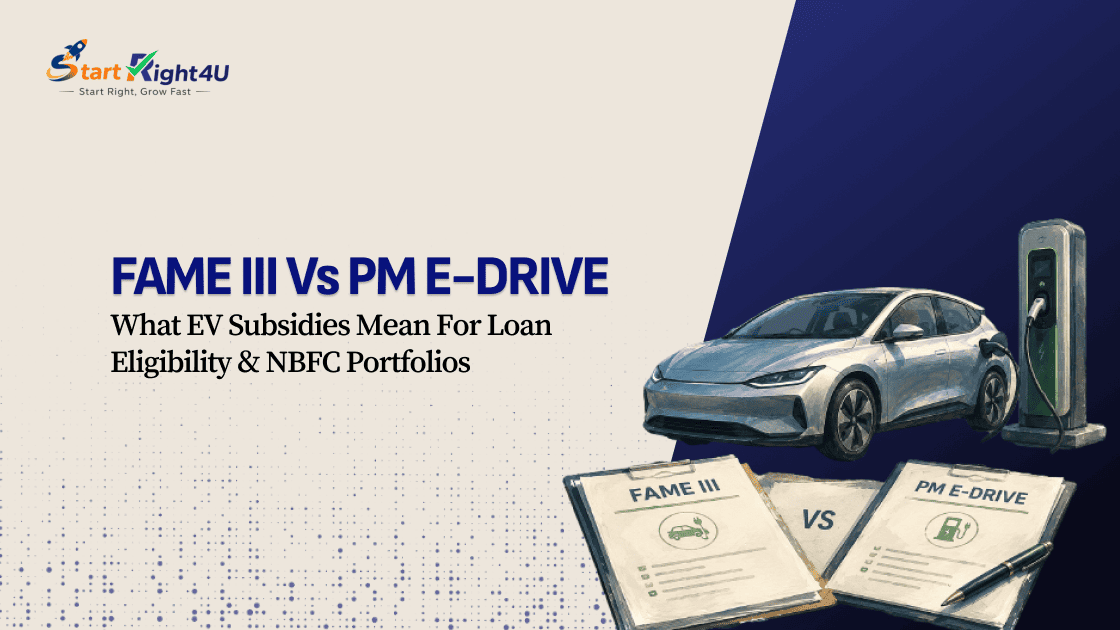
Anyone tracking India's electric vehicle financing space in 2026 has probably run into the same confusing wall of acronyms: FAME II, EMPS, PM E-DRIVE, and now the much-discussed FAME III. For a buyer trying to figure out whether their loan EMI will go up next month, or for an NBFC credit manager trying to model risk on a two-wheeler EV book, this confusion isn't academic; it directly affects affordability, underwriting, and portfolio health. This article breaks down what's actually changing, why it matters for loan eligibility, and what it means for the NBFCs that have quietly become the backbone of EV retail financing in India.
What Is the Difference Between FAME III and PM E-DRIVE?
This is the single most-searched and most-misunderstood question in the EV finance conversation right now, so it deserves a straight answer: as things stand, FAME III has not been formally notified as a standalone scheme. What replaced FAME II when it lapsed in March 2024 was first a short bridging programme called the Electric Mobility Promotion Scheme (EMPS), and then, from October 1, 2024, the PM Electric Drive Revolution in Innovative Vehicle Enhancement Scheme — better known as PM E-DRIVE. Industry commentary, news reports, and even some government signalling have used "FAME III" loosely to describe this next phase of EV incentives, but the scheme that is actually operational on the ground today is PM E-DRIVE, run by the Ministry of Heavy Industries with a sanctioned outlay of roughly ₹10,900 crore.
The practical distinction matters because borrowers and dealers sometimes assume FAME III is a separate, additional subsidy layered on top of PM E-DRIVE. It isn't. PM E-DRIVE effectively absorbed the unfinished targets of FAME II and EMPS into one continuing programme, with demand incentives capped per kWh of battery capacity, vehicle-specific subsidy ceilings, and a sunset clause for the purchase-incentive component. Where "FAME III" becomes relevant is in forward-looking policy discussions: legal and industry analysts have floated it as the eventual successor once PM E-DRIVE's demand-incentive component winds down, possibly incorporating lessons from FAME I and FAME II around localisation enforcement, charging infrastructure gaps, and financing access. Until a fresh cabinet-approved notification appears, treating "FAME III" as live policy can lead buyers and NBFCs to make decisions based on a scheme that, technically, doesn't yet exist in operational form.
Is PM E-DRIVE the Same as FAME III in 2026?
No — and this distinction is worth repeating because so many search results conflate the two. PM E-DRIVE is the scheme presently disbursing subsidies through OEMs and dealers. It was notified on September 29, 2024, runs through specific category-wise terminal dates, and has already seen its timeline adjusted more than once. The demand incentive component for electric two-wheelers and three-wheelers was originally slated to end on March 31, 2026, but has since been extended — e-2Ws now run till July 31, 2026, and e-3Ws (e-rickshaws and e-carts) till March 31, 2028, while the L5 category of e-three-wheelers was closed to new claims from December 26, 2025. Meanwhile, "FAME III," in the sense most articles use the term, remains a policy expectation rather than a notified scheme. So when someone searches "FAME III vs PM E-DRIVE," the accurate framing isn't really a side-by-side comparison of two active schemes — it's an explanation of how PM E-DRIVE is the present reality, and FAME III is the anticipated next chapter that the EV financing ecosystem is bracing for.
Why Does This Subsidy Confusion Matter for EV Loan Eligibility?
Subsidy structure affects loan eligibility in a far more direct way than most first-time EV buyers realise. When a buyer walks into a dealership, the demand incentive under PM E-DRIVE is deducted upfront from the invoice price by the OEM before the dealer even quotes a final price. That means the loan amount a buyer applies for is calculated on the post-subsidy price, not the full ex-showroom cost. A reduction in subsidy — or its complete withdrawal once a scheme's terminal date passes — pushes the effective purchase price up, which in turn increases the loan-to-value requirement, the EMI burden, and the income threshold a lender will want to see before approving the loan.
This is precisely the dynamic playing out with the looming subsidy cliff. Industry estimates suggest that the loss of direct purchase incentives could push prices for affected electric two- and three-wheeler models up by anywhere between 20 and 40 percent, depending on battery size and vehicle category. For a segment where the subsidy can represent 25 to 35 percent of the ex-factory price on a popular three-wheeler model, that's not a marginal shift — it changes the entire affordability calculation lenders use. A borrower who comfortably qualified for a loan when the subsidy was active may suddenly find themselves needing a larger down payment, a co-applicant, or a longer tenure to keep EMIs within an acceptable debt-to-income ratio once that price cushion disappears.
There's a second, less obvious layer too: Section 80EEB of the Income Tax Act allows a deduction of up to ₹1,50,000 per year on interest paid for a loan taken to purchase an electric vehicle. This isn't tied to FAME or PM E-DRIVE directly, but it interacts with loan structuring decisions — borrowers and their relationship managers often factor this tax benefit into how much loan to take and over what tenure, since a higher interest outgo (within reason) can mean a larger annual deduction. Subsidy changes that alter the principal loan amount also change how much benefit a borrower can realistically draw from this provision.
How Are NBFCs Pricing Risk Around the EV Subsidy Transition?
Non-Banking Financial Companies have emerged as the dominant financiers in India's EV retail segment, particularly for electric two-wheelers and three-wheelers where banks have historically been more conservative due to thinner asset history, lower resale liquidity, and borrower profiles that often sit outside traditional banking relationships. This dominance means NBFCs are more exposed than anyone else to the downstream effects of subsidy volatility.
When a scheme like PM E-DRIVE keeps prices artificially lower than they'd otherwise be, NBFCs can underwrite loans against a relatively predictable price band, build standardised loan-to-value ratios for popular models, and assume a certain resale value floor if repossession becomes necessary. The moment a subsidy lapses or shrinks — as is now happening category by category under PM E-DRIVE's staggered terminal dates — that predictability breaks down. Underwriting teams have to recalibrate loan-to-value norms almost model by model, because a scooter that was financed at one price point in February might cost 20-30 percent more in August once its category's incentive window closes, even though nothing about the vehicle itself has changed.
This has a direct bearing on portfolio quality. Loans originated just before a subsidy deadline, when buyers rush to lock in lower prices, often carry compressed underwriting timelines and can include borrowers who stretched their eligibility to beat the deadline. Lenders who have lived through similar subsidy cliffs in the past — including the transition from FAME II to EMPS in 2024 — have seen exactly this pattern: a pre-deadline sales and loan-origination spike, followed by a post-deadline demand slump as the unsubsidised price resets buyer expectations. NBFCs with concentrated EV two-wheeler and three-wheeler books need to watch this rhythm closely, because both ends of that cycle carry distinct risks — origination quality risk before the deadline, and demand/collateral value risk after it.
What Happens to NBFC Loan Portfolios When EV Subsidies Are Withdrawn?
The most immediate portfolio impact of subsidy withdrawal is on collateral valuation. EV loans, especially for two-wheelers and three-wheelers used commercially by delivery riders, e-rickshaw operators, and small logistics fleets, are typically secured against the vehicle itself. If the resale market price of these vehicles was implicitly anchored to a subsidised on-road price, the removal of that subsidy doesn't just affect new buyers — it can also compress resale values for the existing loan book, because second-hand EVs now compete against a market where new EVs are comparatively pricier and ICE alternatives look relatively more attractive again. A thinner resale market makes recovery harder in default scenarios, which is a real concern for NBFCs that have built meaningful exposure in the commercial e-3W segment, where loan ticket sizes are higher and the borrower's income is often directly tied to daily vehicle usage.
There's also a behavioural dimension. Commercial EV borrowers — particularly e-rickshaw and last-mile delivery operators — tend to be thin-file or new-to-credit customers who were drawn into formal lending specifically because EVs became affordable through subsidies plus financing. If the unsubsidised price pushes these vehicles out of reach, NBFCs that built growth strategies around this segment may see origination volumes slow, which forces a strategic pivot: either tightening eligibility criteria to protect asset quality, diversifying into other EV categories like e-buses and e-trucks (which PM E-DRIVE continues to support with extended timelines), or leaning more heavily on state-level incentives that continue independently of the central scheme's wind-down.
It's worth noting that more than 25 Indian states and union territories run their own EV policies layered on top of central incentives — covering road tax exemptions, registration fee waivers, and in some cases interest subvention on EV loans. NBFCs with strong state-level intelligence can use these overlapping benefits to keep effective borrower costs manageable even as central subsidies taper, which is becoming an important differentiator in how lenders structure their EV loan products region by region.
How Should NBFCs Adjust Underwriting Models for the Post-Subsidy EV Market?
The schemes coming and going is, in many ways, less important than how quickly an NBFC's credit policy can adapt to each change. A few patterns are becoming clear across lenders who are managing this transition well. First, underwriting is shifting away from static, subsidy-anchored price assumptions toward dynamic pricing models that get updated each time a scheme category's terminal date passes or a new state notification changes the incentive structure. Second, loan-to-value ratios are being recalibrated category-wise rather than applied uniformly across the EV book — a commercial e-3W with continuing PM E-DRIVE support until 2028 carries a different risk profile than an e-2W whose demand incentive is closer to expiry.
Third, and this is increasingly important, NBFCs are building in subsidy-status checks as a formal part of the loan application process, since eligibility for the incentive itself depends on factors like battery chemistry (lithium-based, not lead-acid), minimum localisation norms, and whether the specific OEM model is currently registered under the scheme. A loan sanctioned without verifying that the underlying vehicle actually qualifies for the advertised incentive can leave both borrower and lender exposed if the subsidy claim is later rejected, leaving a funding gap that nobody priced for. Finally, several lenders are using the post-subsidy price reset as a prompt to widen tenure options and rework EMI structures, so that affordability is preserved through loan structuring even as upfront vehicle costs rise.
Will FAME III Bring Better Financing-Linked Incentives Than PM E-DRIVE?
This is genuinely an open question, but the policy commentary so far gives some useful hints. Analysts examining the gap between FAME II and what India still lacks compared to global EV markets have pointed out that India has largely focused on upfront purchase-price subsidies, while several other countries combine that with financing-side incentives — priority lending arrangements, interest rate subvention specifically for EV and charger financing, and grants tied to financing infrastructure rather than just the vehicle price. Whether a future FAME III incorporates anything resembling this is unconfirmed, but it would be a meaningful shift if it did, because it would address the financing bottleneck more directly than a one-time price reduction can.
For NBFCs, this is worth watching closely, because financing-linked incentives — if they ever materialise — would change the underwriting conversation entirely. Instead of NBFCs absorbing the volatility of subsidy cliffs on their own books, a scheme that subsidises the cost of credit itself would effectively share that risk with the government, making EV lending more attractive and potentially expanding the segment to borrower profiles that current pricing keeps out of reach. Until such a scheme is formally notified, though, this remains speculative, and credit teams should avoid building long-term portfolio strategy around a policy that hasn't been cabinet-approved yet.
What Should EV Buyers Check Before Taking a Loan in the Current Subsidy Environment?
For someone actually shopping for an EV loan today, the practical takeaway from all of this policy back-and-forth is fairly simple, even if the policy landscape itself isn't. It's worth confirming, before signing any loan paperwork, whether the specific model is currently registered and eligible under PM E-DRIVE, since eligibility is model-specific rather than brand-wide. It's also worth checking the category's terminal date — a two-wheeler bought today behaves very differently, subsidy-wise, from a three-wheeler bought under a category with a 2028 runway. Buyers should ask their lender directly whether the quoted loan amount already reflects the post-subsidy price, since the incentive is typically deducted before the loan application is even filed, and confirm whether any state-level benefits — road tax waivers, registration exemptions, or interest subvention — apply on top of the central scheme in their state of registration. None of this requires deep policy expertise; it just requires asking the dealer and the lender to be specific rather than assuming "EV subsidy" means the same thing it did a year ago.
The Bigger Picture for India's EV Lending Ecosystem
What's playing out right now isn't really a story about FAME III versus PM E-DRIVE in isolation — it's a story about how subsidy-dependent an entire financing ecosystem has become, and what happens as that dependency gets tested. PM E-DRIVE's staggered terminal dates mean different vehicle categories are hitting their own subsidy cliffs at different times over the next two years, which gives NBFCs a somewhat unusual advantage: instead of one abrupt, system-wide shock, this is unfolding category by category, giving credit teams a real window to adjust underwriting, pricing, and risk models before each transition hits. Lenders who treat this as a one-off announcement to react to, rather than an ongoing recalibration to manage, are the ones most likely to see asset quality slip as prices reset.
For buyers, dealers, and NBFCs alike, the practical skill that matters most right now isn't predicting exactly when or how FAME III will arrive — nobody can do that with certainty yet — it's staying current with each scheme update as it's notified, and building loan structures flexible enough to absorb the price shifts that come with it. This is also where a lot of the day-to-day friction in EV financing actually lives: not in grand policy debates, but in the smaller, recurring work of checking a borrower's documentation, verifying eligibility against the latest scheme notification, structuring a loan that still works after a subsidy changes, and making sure compliance paperwork keeps pace with how quickly these rules move. This is the kind of operational, behind-the-scenes support that teams like StartRight4U end up being useful for — not by predicting policy, but by helping lenders and EV-focused businesses keep their loan processing, documentation, and compliance workflows accurate and current as schemes like PM E-DRIVE evolve, so that the people actually approving and servicing these loans aren't caught off guard every time a notification changes. In a financing environment where the rules genuinely do shift every few months, that kind of steady, on-the-ground support tends to matter a lot more than any single subsidy headline.