Compliance
EV Financing Opportunities in India
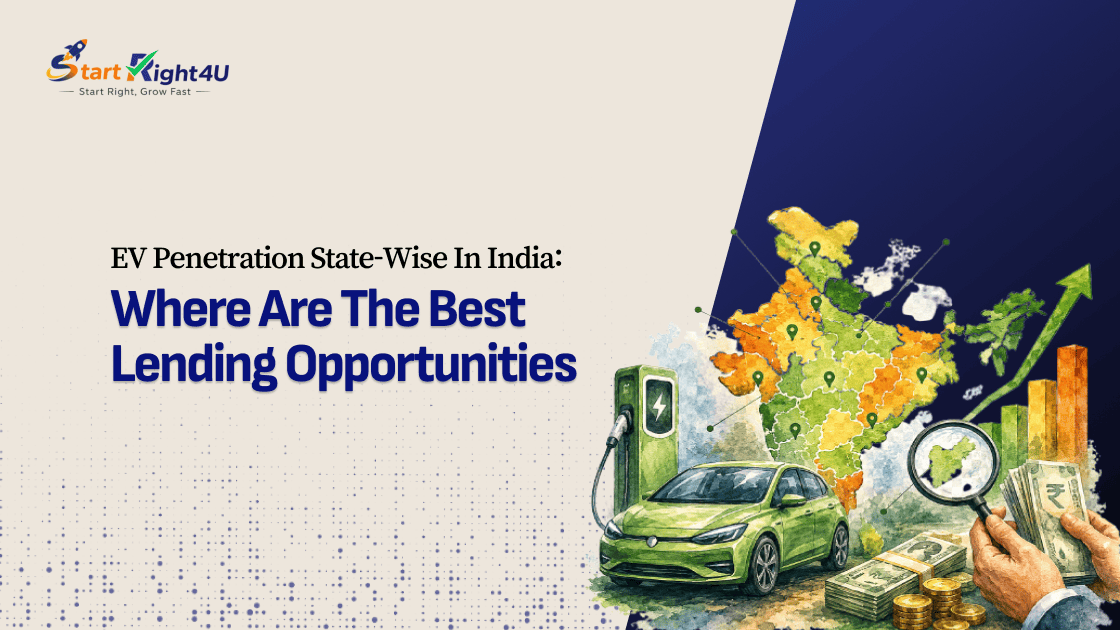
India's electric vehicle story has quietly moved from a policy conversation to a credit conversation. For years, the headlines were about charging infrastructure, subsidy schemes, and which state had announced the boldest EV policy. Somewhere along the way, a quieter but far more consequential shift happened: EVs stopped being a niche purchase and started becoming a mainstream financed asset. Overall EV penetration in India touched roughly 8.5% of total vehicle registrations in FY2025-26, up from 7.7% a year earlier, with total registrations crossing 25 lakh units. That single statistic hides a much more interesting story underneath it — because EV adoption in India is not happening evenly. It is happening in clusters, in specific states, specific vehicle categories, and specific income brackets, and each of those clusters represents a different kind of lending opportunity.
For banks, NBFCs, fintech lenders, and even individual investors thinking about entering the green mobility credit space, the real question is no longer "should we finance EVs?" It is "where, and for whom, does EV financing actually make money?" This article breaks down the state-wise EV penetration landscape in India, decodes what it means for lenders, and identifies where the smartest credit opportunities are hiding in plain sight.
Which Indian States Have the Highest EV Penetration Right Now?
If you only look at raw sales numbers, the story seems obvious — Uttar Pradesh, Maharashtra, Karnataka, Tamil Nadu, and Rajasthan dominate, together accounting for close to half of India's cumulative EV sales. But sales volume and penetration rate are two very different metrics, and lenders who confuse the two often end up chasing the wrong markets.
Penetration rate tells you what share of new vehicle registrations in a state are electric — essentially, how "EV-ready" the buying culture already is. On this metric, the leaderboard looks completely different. Tripura recorded the highest EV penetration in FY2025-26 at nearly 17.8%, followed by Assam at around 15.6%, Delhi at roughly 12.6%, Kerala above 11%, and Goa close to 11% as well. In the passenger four-wheeler segment specifically, Telangana leads with penetration above 11%, followed by Chandigarh and Delhi, while Kerala and Maharashtra also post strong four-wheeler EV shares.
This divergence matters enormously for lending strategy. A state like Uttar Pradesh sells enormous EV volumes because of its sheer population and its e-rickshaw and e-cart economy, but its overall penetration rate is comparatively modest, meaning there is still a long runway of first-time EV buyers who will need credit. A state like Tripura or Assam, on the other hand, already has a buying culture tilted toward electric, which usually signals lower resistance to EV loans, better resale confidence, and a maturing ecosystem of dealers and service centres that reduces a lender's residual-value risk.
Why Does State-Wise EV Penetration Matter More to Lenders Than National Averages?
National EV penetration figures are useful for boardroom presentations, but they are almost useless for underwriting decisions. A national average of 8.5% penetration masks the fact that some RTOs are already seeing EV shares above 15-17%, while others remain in low single digits. Lenders who price risk, design loan products, and set branch or partner priorities based on national numbers alone will inevitably misallocate capital — either underpricing risk in low-penetration markets where infrastructure and resale value are still uncertain, or overpricing it in high-penetration corridors where the credit risk has already normalised.
State-wise penetration data essentially functions as a proxy for ecosystem maturity. Higher penetration usually correlates with denser charging infrastructure, more established service networks, stronger OEM after-sales presence, and — critically for a lender — better resale and repossession value if a loan turns delinquent. Karnataka, for instance, leads the country in public charging stations, with roughly 6,096 stations as of December 2025, well ahead of Maharashtra. That infrastructure density directly reduces "range anxiety" risk for borrowers and improves the collateral quality for lenders financing four-wheelers and fleet vehicles in the state.
What Does the Vehicle-Category Split Tell Lenders About Where the Real Volume Is?
Any lending strategy for the Indian EV market has to start with an honest look at category mix, because the four-wheeler passenger car segment, despite getting the most media attention, is actually the smallest slice of the pie. Electric two-wheelers account for close to 58% of total EV sales in India, electric three-wheelers (passenger and cargo combined) make up close to a third of the market, and electric four-wheelers — cars, SUVs, and commercial vehicles — represent a comparatively small single-digit share of total EV volume, even though four-wheeler penetration within the car segment itself is rising steadily and touched around 6.6% in May 2026.
This is precisely why the most active and highest-volume EV lenders in India today are not necessarily the ones writing the biggest-ticket car loans. They are the NBFCs and fintechs financing e-rickshaws, e-carts, and delivery two-wheelers in tier 2 and tier 3 towns, where ticket sizes are small, but volumes are enormous and repayment cycles are short. Nearly 45% of all three-wheelers sold in India today are electric, and this segment is disproportionately financed rather than bought outright, because the buyer is very often a first-time entrepreneur — a gig driver, a small logistics operator, or a delivery partner — who needs the vehicle to earn a livelihood and therefore has both the motivation and the cash-flow discipline to service an EMI reliably.
Which States Offer the Strongest Two-Wheeler and Three-Wheeler Lending Opportunities?
Two-wheeler EV penetration crossed 9% nationally in May 2026, and this segment is being driven overwhelmingly by urban commuters and gig-economy delivery riders rather than traditional two-wheeler buyers. States with dense last-mile delivery ecosystems — Maharashtra, Karnataka, Delhi-NCR, Tamil Nadu, and increasingly Uttar Pradesh — are seeing the fastest growth in financed e-scooter and e-motorcycle purchases, largely because logistics and quick-commerce companies are pushing fleet electrification down to their gig workforce.
The three-wheeler segment tells an even sharper regional story. West Bengal's decision to make e-rickshaw registration mandatory triggered a spike in passenger e-3W sales, pushing this category to a record high in December 2025 before PM E-DRIVE incentives for that category were exhausted. This kind of regulatory nudge is a textbook signal for lenders: whenever a state government moves from "encouraging" EV adoption to "mandating" it in a specific vehicle category, a wave of credit demand follows almost immediately, because buyers who previously used older diesel or CNG three-wheelers are forced into a compliance-driven upgrade cycle, and very few of them can pay the full amount upfront.
Beyond West Bengal, states like Uttar Pradesh, Bihar, and Rajasthan remain the volume engines of the e-rickshaw and e-cart economy, largely because these vehicles form the backbone of informal urban and semi-urban transport. Bihar's own EV policy targets 15% EV incorporation across all vehicle registrations by 2028, which signals sustained policy tailwinds for lenders willing to build underwriting models suited to informal-income borrowers in these markets.
How Is the Four-Wheeler EV Lending Opportunity Different From Two- and Three-Wheelers?
Financing an electric car is structurally a different business from financing an e-rickshaw, and lenders need to treat it that way. The four-wheeler EV buyer is typically a salaried or self-employed individual with an existing credit history who often already owns a vehicle and is making a discretionary upgrade rather than a livelihood purchase. This means smaller absolute volumes but significantly higher ticket sizes and a borrower profile that banks find easier to underwrite using conventional credit-bureau data.
Maharashtra currently sells the highest volume of electric cars in the country, followed by Karnataka and Kerala, while Telangana, Chandigarh, and Delhi post the highest penetration rates within the four-wheeler category specifically. The competitive intensity in this segment has also increased sharply — Tata Motors' dominance in electric cars fell from roughly 57% market share to closer to 39% within a single year, as JSW MG Motor, Mahindra, Hyundai, and new entrants like VinFast and Maruti Suzuki expanded aggressively, particularly in the ₹12-25 lakh price band that represents the heart of urban SUV demand. For lenders, a fragmenting OEM landscape combined with rising model variety is actually good news: it broadens the pool of financeable vehicles, improves resale liquidity through a wider secondary market, and reduces concentration risk that comes from over-exposure to a single manufacturer's residual value curve.
Maharashtra deserves particular attention here, because it layers an additional battery-capacity subsidy of roughly ₹930 per kWh on top of central incentives, which effectively lowers the total cost of ownership and, by extension, compresses the effective interest burden for eligible borrowers by an estimated 200-300 basis points. States that stack their own incentives on top of PM E-DRIVE are, in effect, subsidising a lender's credit risk indirectly, because a lower total loan principal and a more price-sensitive, incentive-aware buyer tends to default less often.
What Is Actually Slowing Down EV Loan Growth in India Today?
Despite the optimism, EV financing in India has historically carried real friction that any serious lender needs to price in rather than ignore. Loan-to-value ratios on EVs have typically run 10-30% lower than equivalent ICE vehicle loans, which pushes up the down payment burden on buyers who are often already stretching their budgets to go electric. Interest rates on EV loans have also tended to run 1-9% higher than conventional vehicle loans, with tenures 6-18 months shorter, largely because lenders remain uncertain about resale value and battery degradation over the life of the loan. Industry estimates suggested that India would need somewhere between ₹45,000-55,000 crore in financing to support EV purchases, and a meaningful part of that demand has gone unmet simply because fewer banks and NBFCs were comfortable underwriting the asset class compared to traditional vehicles.
The encouraging part is that this gap is closing fast. EV loan interest rates in 2026 now range roughly between 7.99% and 11.5%, with some public sector banks offering EV-specific "green" loan products starting as low as 8.55% for electric cars, and most lenders now financing 85-100% of the ex-showroom price. The Reserve Bank of India's revised Priority Sector Lending guidelines have also brought EV financing more clearly within priority-sector classification, which reduces the cost of capital for banks extending green loans and, in turn, allows them to pass on better rates to borrowers. Add to this the rise of co-lending arrangements, First Loss Default Guarantee structures with larger banks, and refinancing support programs like SIDBI's initiative for EV-focused NBFCs, and the structural barriers that once made EV lending unattractive are steadily being dismantled.
Which Lenders Are Winning the EV Financing Race, and What Can Be Learned From Them?
India's EV credit market currently runs on two parallel tracks — banks and NBFCs — each playing to different strengths. Banks like the State Bank of India have built dedicated green car loan products and generally attract higher credit-quality borrowers because of their lower cost of funds, but banks tend to be conservative in flexible repayment structuring and slower in reaching semi-urban and rural markets. NBFCs, by contrast, now account for more than half of the formal auto-lending market in India, and their real competitive edge lies in flexibility — smaller ticket sizes, faster disbursal, doorstep collections, and a far greater willingness to lend in tier 2 and tier 3 towns where bank branch density is thin.
Captive NBFCs tied to OEMs, such as those partnered with major two- and three-wheeler manufacturers, benefit from built-in distribution through dealership networks, while non-captive and fintech-first lenders are increasingly using AI-driven underwriting models to compress loan approval times from weeks down to minutes. This shift toward digital, data-driven underwriting is arguably the single biggest structural change in the market — it is what is allowing new-age lenders to profitably serve gig-economy borrowers and first-time entrepreneurs who don't fit neatly into traditional credit-bureau-based risk models. The overall EV financing market in India, valued at roughly $2.37 billion in 2025, is projected to grow at a compound rate above 50% annually through 2031, and fintech lenders specifically are expanding even faster than that average, which tells you exactly where the next wave of competitive advantage is being built.
How Should a New Lender Decide Which State or Segment to Enter First?
For any bank, NBFC, or fintech evaluating where to deploy fresh EV lending capital, the decision really comes down to matching risk appetite with market maturity. A conservative, bank-style lender with a lower risk tolerance and access to cheap capital is best positioned in high-penetration, infrastructure-rich states like Telangana, Delhi, Karnataka, and Maharashtra, financing four-wheelers and formal fleet operators where resale value, charging density, and borrower credit history are all relatively well established.
A more aggressive NBFC or fintech lender, comfortable with smaller ticket sizes and higher-touch collections, will find far more fertile ground in the two- and three-wheeler economy of Uttar Pradesh, Bihar, Rajasthan, and West Bengal, where regulatory tailwinds — such as mandatory e-rickshaw registration — are actively pushing informal-sector borrowers toward financed EV purchases. States like Assam, Tripura, and Kerala, which already show unusually high penetration relative to their size, represent a middle path: smaller absolute markets, but ones where the buying culture has already normalised EV ownership, reducing both awareness-building costs and resale risk for a lender entering fresh.
Whichever path a lender chooses, one theme holds true across all of them: the state government's own EV policy stance is now a leading indicator of credit demand almost as reliable as income data. States stacking their own subsidies, mandating EV adoption in specific categories, or investing heavily in charging infrastructure are effectively derisking the lending environment before a single loan application is even filed.
What Does the Road Ahead Look Like for EV Lending in India?
India's EV penetration is expected to climb toward 9.5-10% nationally in FY2026-27, with the government's long-term target sitting at 30% penetration by 2030 — a goal that will require roughly one crore EV sales annually and financing needs that dwarf anything the market has handled so far. Getting there is not just an automotive story; it is fundamentally a credit-access story. Every percentage point of additional EV penetration represents thousands of crores of fresh loan origination opportunities, spread unevenly across states, vehicle categories, and borrower profiles that each demand a slightly different underwriting playbook.
For entrepreneurs, NBFC promoters, and fintech founders who see this moment for what it is — a genuine once-in-a-generation credit market forming in real time — the opportunity is less about picking the "best" state on a map and more about matching the right product, the right vehicle category, and the right regulatory tailwind to a market that is still early enough to build real advantage in. The states and segments discussed here are moving targets, not fixed conclusions, and staying ahead means tracking policy announcements, incentive stacking, and RTO-level registration data almost as closely as tracking interest rate movements.
Getting the strategy right on paper is one thing; getting the business structured correctly to actually pursue it is another challenge entirely. Setting up an NBFC, a co-lending arrangement, or a fintech lending entity in India involves navigating RBI registration norms, GST compliance, state-specific incentive documentation, and ongoing regulatory filings that can quietly derail even a well-researched market entry if they aren't handled properly from day one. This is exactly the kind of groundwork that firms like StartRight4U end up supporting founders and finance teams with — helping them get the incorporation, licensing, GST, and compliance foundation right before they start writing their first EV loan, so that the business itself is built on solid legal and financial footing while the founders focus on reading the market, not chasing paperwork.