
RBI
RBI Bars NBFCs From Revolving Credit 2026— Only Term Loans Allowed Now
The Reserve Bank of India has once again put the spotlight on how non-banking financial companies lend money. On August 6, 2026, the central bank released a draft circular regarding RBI Bars NBFCs From Revolving Credit 2026, in simple terms, tells NBFCs to stick to plain term loans and step away from revolving credit products. This move on demand loans and revolving facilities by NBFCs could reshape how millions of borrowers access short-term credit in India. If you run a business that depends on a flexi-loan, an overdraft-style facility, or a digital line of credit from an NBFC, this is one regulatory update you shouldn't skip. Let's break down RBI Bars NBFCs From Revolving Credit in simple terms.
What Exactly Has RBI Proposed?
The RBI has floated draft amendments to the Reserve Bank of India (Non-Banking Financial Company – Credit Facilities) Directions, 2025. The core idea is straightforward: going forward, NBFCs would be allowed to offer only term loan products. They would no longer be permitted to extend revolving credit facilities to borrowers.
In the RBI's own words, an NBFC "shall only offer credit products which are in the nature of term loans and shall not offer any revolving credit products." That's a fairly blunt line, and it signals the intent behind the entire draft.
There's one carve-out worth noting. NBFCs that are specifically authorised by the RBI to issue credit cards will still be allowed to offer revolving credit, since revolving usage is built into how credit cards work. Everyone else in the NBFC space — including large players known for flexi-loans and working capital lines — would need to rework their product structure if this draft becomes final law.
To bring this change into effect, the RBI has proposed two structural steps:
Deleting an existing provision under Chapter II of the 2025 Directions.
Removing the separate chapter that currently deals with Demand and Call Loans, and replacing it with a new section titled "Restrictions on Revolving Credit Facilities."
This is why the discussion around demand loans and revolving facilities by NBFCs has picked up so much traction in financial circles — it isn't a minor tweak; it's a rewrite of how credit products get classified.
Term Loan vs Revolving Credit: How RBI Defines Them
One of the more useful parts of this draft is that, for the first time, the RBI has laid out clear, formal definitions for both terms under its NBFC directions. Earlier, the line between the two was often blurry in practice.
Feature | Term Loan | Revolving Credit |
Sanctioned amount | Fixed, decided upfront | Approved limit that can be reused |
Disbursement | Lump sum or in instalments | Drawn as and when needed |
Repayment | Fixed schedule, predetermined | Flexible, repay and redraw |
Reuse of limit | Not allowed once repaid | Allowed within the approved limit |
Fresh borrowing | Needs new sanction | Automatic, within existing limit |
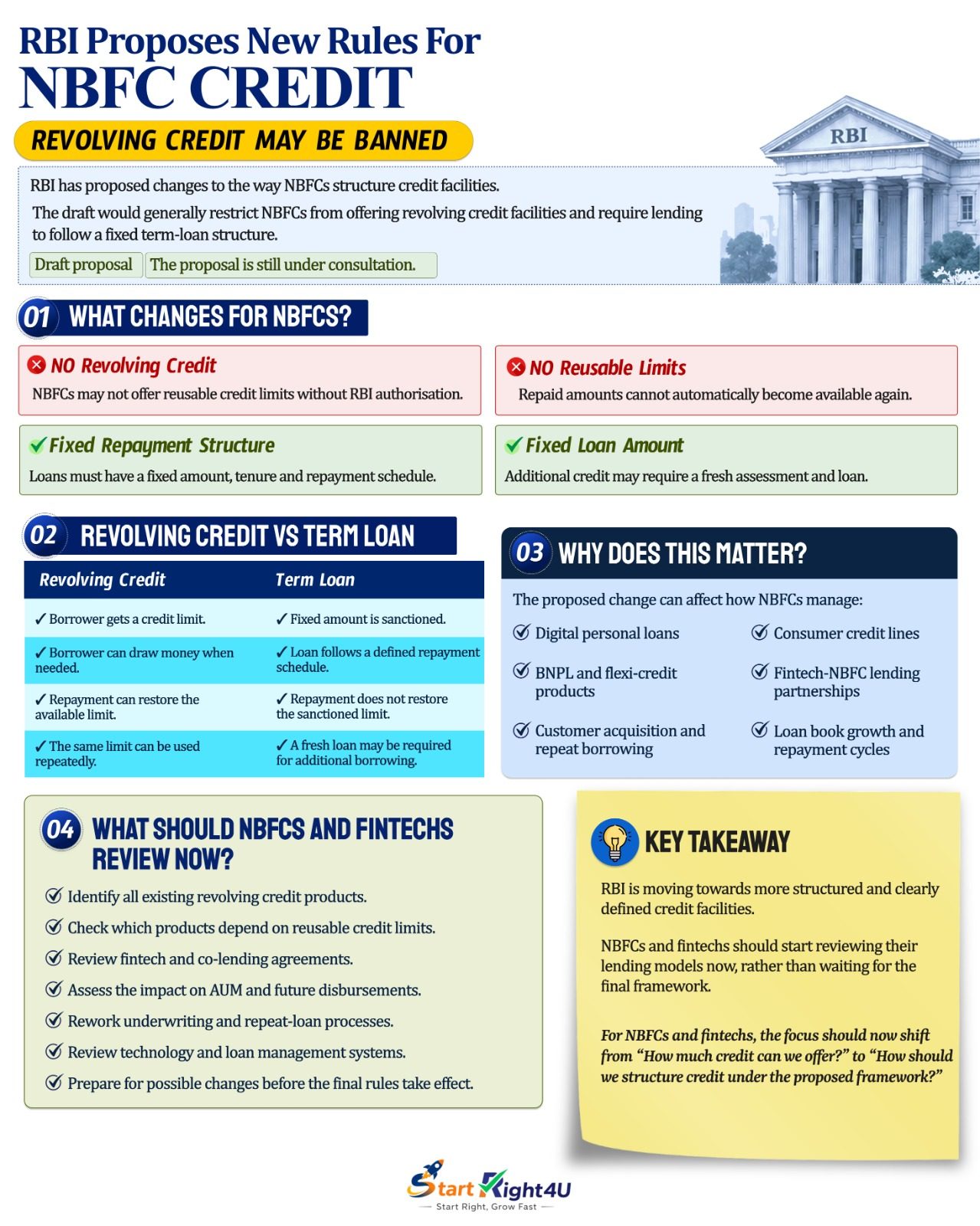
In simple terms, once you repay a term loan, that credit line is closed. If you want more money, the NBFC has to underwrite and sanction it all over again. With revolving credit, the same limit can be tapped, repaid, and tapped again without a fresh approval process — and that's precisely the feature the RBI wants to restrict for most NBFCs. Any fund-based facility that doesn't tick the boxes of a term loan will now be treated as revolving credit under the draft rules, and therefore be off-limits for most NBFCs.
Which Products Get Affected from RBI Bars NBFCs From Revolving Credit?
This restriction would touch a fairly wide basket of lending products. Based on how the draft defines revolving credit, the products most likely to be hit include:
Flexi loans, where borrowers draw and repay within a sanctioned limit
Overdraft-style credit facilities
Digital lines of credit offered by fintech-NBFC partnerships
Cash credit limits extended to businesses
Working capital facilities that allow repeated drawdowns
Demand and call loans, which currently sit in a separate chapter of the existing directions
Supply-chain financing is a slightly trickier case. Industry body FIDC has argued that these arrangements shouldn't be clubbed with card-style revolving credit, since supply-chain finance is typically structured as short-tenure term loans of 30 to 180 days, with each tranche monitored individually for delinquency. Whether the RBI accepts this distinction in the final rules is something the sector is watching closely.
Why is the RBI Doing This?
Regulators rarely make sweeping changes without a reason, and this one appears to be rooted in risk management. According to market analysts, the underlying worry is something called "evergreening" — a situation where a borrower keeps servicing an old loan using fresh drawdowns from the same revolving limit, rather than genuine income or cash flow. Over time, this can mask the real health of a loan book and build up hidden stress in the financial system.
By pushing NBFCs toward the term loan model, the RBI wants every fresh borrowing to go through proper underwriting again. That, in theory, gives lenders a clearer, more current picture of a borrower's repayment capacity each time credit is extended, rather than letting an old sanction quietly roll forward indefinitely.
There's also a borrower-protection angle. Term loans come with fixed schedules and clear end dates, which can make debt easier to track compared to open-ended revolving limits that borrowers can renew almost automatically.
How the Industry is Reacting from RBI Bars NBFCs From Revolving Credit?
Not surprisingly, the NBFC sector isn't entirely on board with a blanket restriction. Several industry voices have flagged concerns since the draft was released i.e., RBI Bars NBFCs From Revolving Credit:
1. Jugal Mantri, ED & CEO of Anand Rathi Global Finance, described it as a significant regulatory shift for the sector, one that would likely reduce flexibility for borrowers, especially those relying on collateral-backed credit lines for working capital or short-term needs. He also pointed out that the fintech and digital lending ecosystem could feel a meaningful impact, given how many digital lenders are built around flexible, reusable credit lines.
2. The Finance Industry Development Council, the self-regulatory body for NBFCs, is collecting feedback from lenders across supply-chain finance, loan-against-property, and MSME lending before it submits a formal response to the RBI. One concern raised by NBFC officials is that a blanket ban could tilt the playing field toward banks, which face no similar restriction and can keep offering working-capital and short-term liquidity products without interruption.
3. Another practical worry: replacing revolving facilities with repeated term loans means more underwriting, more paperwork, and slower turnaround for borrowers every time they need funds — a cost that ultimately gets passed down the chain.
4. That said, reactions aren't uniformly negative. Rajiv Sabharwal, CEO of Tata Capital, said publicly that revolving credit makes up less than 5% of the company's loan book, so the impact on Tata Capital specifically would be limited. He added that the company plans to submit feedback to the RBI and would comply with whatever the final rule looks like.
5. Brokerage estimates give a sense of scale elsewhere. Flexi loans reportedly make up close to 14% of Bajaj Finance's loan portfolio and generate a meaningful yield premium, according to Jefferies. Even so, the brokerage expects only a modest 1–1.5% hit to earnings per share if the rule goes through as drafted — suggesting the sharp stock price reaction seen right after the announcement may have been an overreaction relative to the actual earnings impact.
Market Reaction
NBFC stocks didn't take the news quietly. Shares of several major NBFCs fell in the days following the draft's release, as investors weighed the potential hit to fee income and loan growth. Revolving products typically generate charges every time a borrower draws down funds, so a shift to a pure term-loan model could dent this recurring fee stream for lenders that lean heavily on flexi-credit products.
Key Dates to Track:
Event | Date |
Draft circular released | August 6, 2026 |
Deadline for public feedback | August 28, 2026 |
Effective date, if notified as-is | Immediately upon notification |
Stakeholders — NBFCs, industry bodies, fintechs, and even individual borrowers — have until August 28, 2026, to send their comments to the RBI. Once the feedback window closes, the central bank will review the responses before issuing final directions. If the rule is notified in its current form, it comes into force immediately, which leaves NBFCs very little runway to redesign products once the final word is out.
What This Could Mean for Borrowers?
If you're a business owner or individual who currently uses a revolving credit line from an NBFC, here's a simple rundown of what might change:
You may no longer be able to draw, repay, and redraw funds within the same approved limit.
Every fresh borrowing could require a new loan application and fresh underwriting.
Turnaround time for accessing funds may increase, since each drawdown becomes a separate sanction process.
Products like flexi-loans and overdraft facilities from NBFCs may either be discontinued or restructured as a series of short-tenure term loans.
Borrowers who specifically need revolving credit may need to shift toward NBFCs authorised to issue credit cards, or toward banks, which remain unaffected by this proposal.
For businesses that rely on quick, repeated access to working capital — say, an MSME managing seasonal cash flow gaps — this shift could mean more paperwork and planning ahead, rather than relying on an always-available credit line.
What Happens Next?
This is still a draft, not a final rule. The RBI has explicitly invited public comments, and industry bodies like FIDC are actively preparing detailed feedback highlighting where the proposal might need refinement — particularly around supply-chain finance and other structured short-term products that don't behave like traditional revolving credit but also don't cleanly fit the term loan definition either.
Given how the RBI has handled similar consultations in the past, it's reasonable to expect the final directions could include some tweaks or additional exemptions based on the feedback received. But the broad direction — pushing NBFCs toward standard term loans and away from open-ended revolving products — appears to be a firm regulatory priority.
Conclusion
RBI Bars NBFCs From Revolving Credit proposal marks one of the more significant regulatory shifts for India's shadow banking sector in recent years. It aims to close a structural gap between how banks and NBFCs are regulated, tighten oversight on loan evergreening, and bring more discipline into how credit is renewed and reused. For NBFCs, especially those with a large flexi-loan or working-capital book, the coming weeks will be about making their case to the RBI. For borrowers, it's worth keeping an eye on how your NBFC lender responds, since any change to demand loans and revolving facilities by NBFCs could directly affect how you access short-term credit in the months ahead.