RBI
How to Start a Digital Micro-Lending Platform in India Without an NBFC License
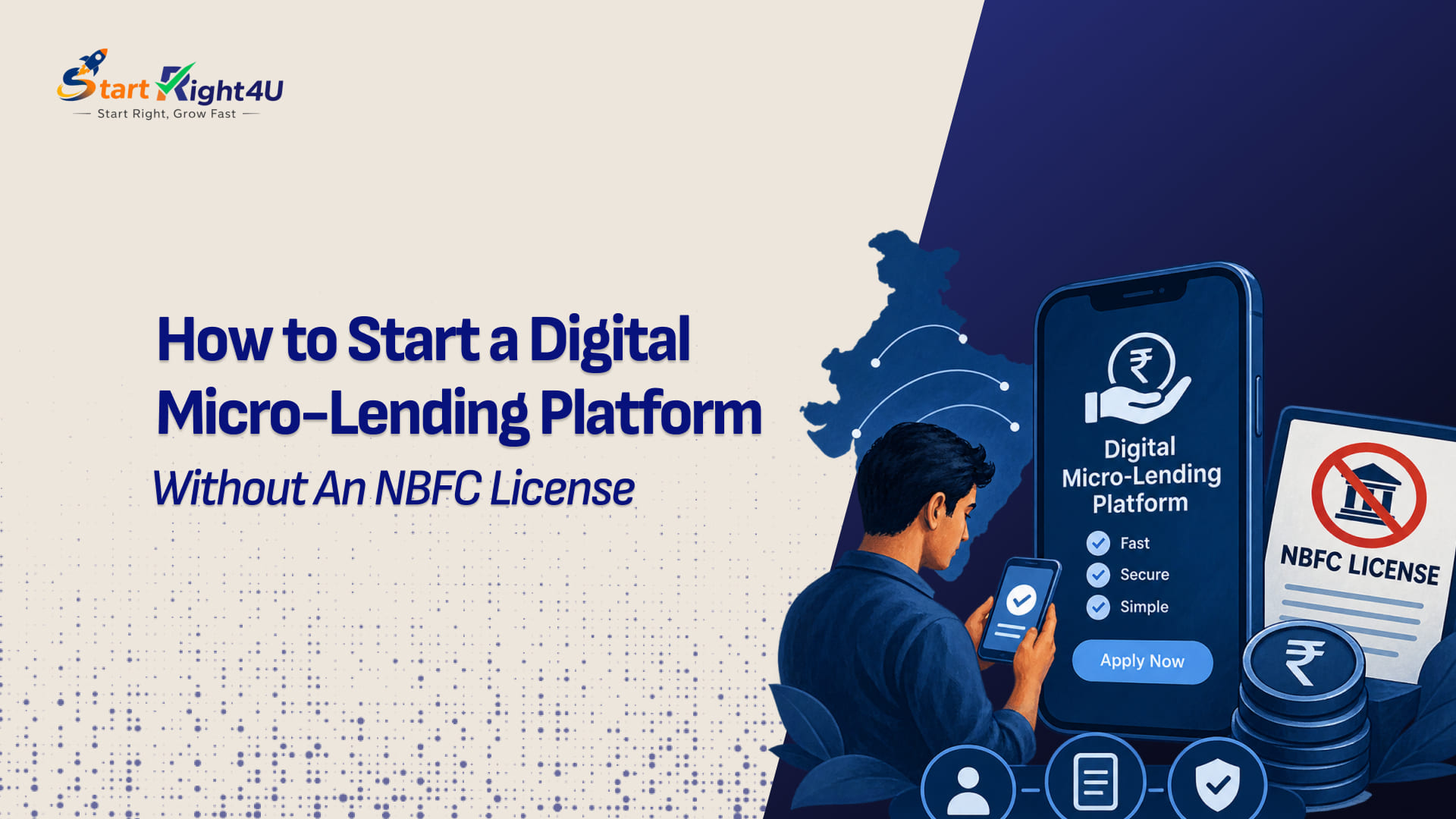
India’s digital lending market offers significant opportunities for fintech startups, technology companies, and financial service providers. With borrowers increasingly using mobile apps to access small-ticket loans, entrepreneurs are exploring ways to enter the lending business without investing ₹10 crore in an NBFC. But there is an important distinction between building a digital lending platform and operating a lending business.
You can build a fintech platform that sources borrowers, processes loan applications, and facilitates digital lending without obtaining your own NBFC licence. However, you must structure the business around a regulated bank or NBFC and comply with the Reserve Bank of India’s (RBI) digital lending regulations.
So, how can you start a digital micro-lending platform in India without an NBFC license? Let’s understand the business models, regulatory requirements, technology infrastructure, and practical steps involved.
Can You Start a Digital Lending Platform Without an NBFC License?
Yes, but the answer depends on the activities your company performs. A technology company can provide digital lending services to a regulated bank or NBFC. It can develop the mobile application, acquire customers, facilitate digital onboarding, integrate credit assessment tools, and manage technology infrastructure.
However, if your company independently carries on the business of lending as an NBFC, you cannot avoid RBI registration simply by calling yourself a fintech or technology platform. Under Section 45-IA of the RBI Act, 1934, an NBFC generally requires a Certificate of Registration from the RBI to commence or carry on its regulated business, subject to applicable statutory exemptions.
For most fintech founders, obtaining an NBFC licence can involve substantial capital requirements, regulatory approvals, governance arrangements, and ongoing compliance obligations. The alternative is to operate as a Lending Service Provider (LSP) for an RBI-regulated bank or NBFC. This model allows you to enter the digital lending market without establishing your own lending balance sheet.
What Is the LSP Model in Digital Micro-Lending?
A Lending Service Provider is an agent of a regulated entity that performs lending-related functions under an arrangement with that entity. Under the RBI’s Digital Lending Directions, 2025, an LSP can provide services such as customer acquisition, loan application processing, underwriting support, loan servicing, and recovery support, depending on its contractual responsibilities.
Here is how the model works.
The fintech platform handles:
Developing the mobile application or digital lending website.
Acquiring borrowers through digital marketing and distribution partnerships.
Collecting loan applications and facilitating KYC.
Integrating credit bureaus and financial data services.
Supporting credit assessment and loan processing.
Providing customer support, repayment reminders, and servicing technology.
The partner bank or NBFC handles:
Lending from its own funds.
Making the final credit decision.
Setting applicable interest rates and loan terms.
Disbursing the loan and receiving repayments through permitted channels.
Maintaining regulatory responsibility for the lending activity.
Meeting applicable capital adequacy, reporting, and prudential requirements.
The regulated lender remains responsible for its obligations under RBI regulations. Outsourcing activities to an LSP does not transfer those responsibilities to the fintech.
How Does the Fintech Earn Revenue?
An LSP can earn revenue under a contractual arrangement with the regulated lender. Depending on the services provided, this may include technology fees, customer acquisition fees, or servicing fees.
The commercial arrangement must be transparent and compliant with applicable RBI requirements. The regulated lender cannot pass its responsibility for paying LSP fees to the borrower through a prohibited arrangement.
For example, a fintech can build a micro-loan application for borrowers seeking loans of ₹5,000 to ₹50,000. A partner NBFC evaluates eligible applications, approves loans, and disburses funds directly to borrowers. The fintech earns an agreed service fee from the NBFC.
This approach allows the fintech to build its distribution network and technology business without independently funding the loan portfolio.
LSP Model vs Co-Lending Model
Although these models may involve partnerships between financial institutions and fintech companies, they serve different purposes.
Parameter | LSP Model | Co-Lending Model |
Primary role | Facilitates lending services | Enables lending by participating regulated lenders |
Capital contribution | LSP generally does not fund loans | Participating lenders contribute funds under the applicable arrangement |
Credit risk | The regulated lender retains the lending risk, subject to permitted arrangements | Each lender bears its contractual share of credit exposure |
Fintech's role | Technology, sourcing, processing, and servicing | May provide technology or sourcing support |
Regulatory position | LSP operates under a service arrangement | Regulated lenders must comply with applicable co-lending requirements |
A fintech does not become a co-lender simply because it works with an NBFC. Co-lending involves a specific lending arrangement between eligible regulated entities under the applicable framework. For founders seeking to enter digital micro-lending without their own NBFC registration, the LSP model is generally the more straightforward starting point.
RBI Digital Lending Directions, 2025: Key Compliance Requirements
The RBI's Digital Lending Directions, 2025, strengthen requirements around transparency, customer protection, fund flows, data handling, and lender accountability. Before launching your platform, build the following requirements into your business model.
A. Direct Loan Disbursement
Loan disbursements must generally move directly from the regulated lender to the borrower's bank account, subject to the specific exceptions permitted under RBI directions.
Your fintech should not route loan funds through its own bank account or use its account as an unauthorised intermediary for disbursements or repayments. Design your payment architecture around the lender's approved banking and payment arrangements from the beginning.
B. Key Fact Statement and Loan Pricing
Borrowers must receive the applicable Key Fact Statement (KFS) before entering into the loan agreement. The KFS communicates essential loan information, including the Annual Percentage Rate (APR), applicable charges, repayment schedule, and other prescribed terms.
Your platform should display loan costs clearly and avoid misleading claims such as zero-cost credit when mandatory charges apply.
C. Customer Data and Storage
Digital lending platforms process sensitive information, including identity documents, financial records, bank statements, and credit histories.
The RBI's Digital Lending Directions prescribe requirements for data collection, storage, consent, and access. Regulated entities must ensure that applicable digital lending data is stored on servers located in India, subject to the directions' provisions for data processing outside India.
Your technology architecture should support:
Explicit and informed consent for data collection.
Collection of only the data required for the stated purpose.
Restricted access to sensitive information.
Secure storage, encryption, and audit trails.
Appropriate data retention and deletion policies.
Compliance with applicable privacy and cybersecurity requirements.
Do not collect contacts, call logs, or unrelated personal information merely because your application can access it.
D. Multiple Lenders and Loan Offer Display
If your platform works with multiple banks or NBFCs, you must follow the applicable requirements for displaying available loan offers. The RBI's 2025 framework requires relevant multi-lender platforms to present eligible offers from willing regulated lenders neutrally and transparently. Important information includes the lender's name, loan amount, APR, tenor, and other relevant terms.
The platform must not use dark patterns to steer borrowers towards a particular offer without a legitimate, transparent basis. Build the comparison interface to help borrowers make informed decisions rather than simply promote the lender offering the highest commercial fee.
E. Grievance Redressal and Recovery Practices
Your platform should clearly identify the regulated lender and provide borrowers with appropriate grievance redressal channels. Recovery communications must follow applicable rules and the lender's approved policies. Your technology should support complaint tracking, communication records, and escalation to the responsible lender.
These requirements should be part of the initial product design, not features added after launch.
FLDG Rules: Can a Fintech Guarantee Loan Defaults?
First Loss Default Guarantee (FLDG) arrangements can help fintechs demonstrate confidence in their borrower sourcing and credit assessment capabilities. Under an eligible arrangement, an LSP may agree to compensate a regulated lender for specified losses arising from defaults in a loan portfolio.
However, RBI regulations restrict these arrangements. Under the RBI's applicable Digital Lending framework, the DLG cover is generally capped at 5% of the amount disbursed from the covered loan portfolio, subject to the prescribed conditions.
For example, if the relevant covered loan portfolio has eligible disbursements of ₹10 crore, the 5% cap would ordinarily limit the DLG cover to ₹50 lakh.
The arrangement must meet the applicable requirements concerning eligible DLG providers, contractual documentation, permitted forms of guarantee, disclosures, and recognition of the guarantee by the regulated lender. A fintech cannot use an unlimited default guarantee to assume the entire lending risk while presenting itself as a technology intermediary. The partner NBFC must maintain its own credit assessment, risk management, and regulatory responsibilities.
Technology Stack Required to Launch a Digital Micro-Lending Platform
Your platform needs more than a borrower-facing mobile application. It requires an integrated technology stack that supports the full loan lifecycle.
Technology Component | Purpose |
Loan Origination System (LOS) | Captures applications, documents, and application status |
Loan Management System (LMS) | Tracks loan accounts, repayments, overdue amounts, and outstanding balances |
KYC and identity verification | Supports PAN verification, permitted Aadhaar-based verification, and DigiLocker integrations |
Credit bureau APIs | Retrieves credit information from bureaus such as TransUnion CIBIL and Experian, subject to access requirements |
Account Aggregator integration | Facilitates consent-based access to financial information |
Bank and payment APIs | Supports approved disbursement and repayment workflows |
e-NACH and UPI | Supports suitable electronic repayment and collection arrangements |
Fraud detection tools | Identifies suspicious applications and potential identity fraud |
Data security infrastructure | Supports encryption, access controls, monitoring, and audit trails
|
Reporting and analytics | Tracks portfolio performance, delinquencies, customer acquisition, and operational metrics |
You can build these systems internally or integrate third-party solutions. For an early-stage fintech, buying established software and integrating it with a partner NBFC's systems may reduce development time. However, you must ensure that the solution meets the lender's security, audit, integration, and regulatory requirements.
How to Start a Digital Micro-Lending Platform Without an NBFC License
Step 1: Define your lending niche
Identify your target borrowers. You could focus on small-ticket personal loans, micro-business credit, merchant finance, or other permitted lending segments. Define your expected loan size, repayment period, customer acquisition channels, and underwriting approach.
Step 2: Choose the right business structure
Establish an appropriate legal entity and define whether your company will operate as a technology provider, LSP, or another permitted service provider. Obtain professional advice on the regulatory implications of your proposed activities.
Step 3: Find an RBI-regulated lending partner
Identify banks or NBFCs whose target market, risk appetite, and lending products match your business plan. Evaluate their eligibility, onboarding requirements, underwriting policies, technology interfaces, and commercial terms.
Step 4: Finalise the LSP agreement
Document the responsibilities of both parties, service fees, data access, customer communication, grievance handling, security controls, and termination arrangements. Ensure that the agreement reflects the actual operating model.
Step 5: Build the technology infrastructure
Develop the borrower application, integrate the lender's APIs, implement identity verification, and establish secure loan processing and servicing workflows.
Step 6: Complete compliance and security testing
Test consent management, KFS generation, disbursement flows, data storage, complaint handling, and repayment processes. Conduct appropriate security assessments and resolve identified gaps before launch.
Step 7: Launch with controlled operations
Begin with a defined customer segment and monitor application quality, approval rates, fraud, repayment performance, and complaints.
Review these indicators with your lending partner before expanding to additional products or lenders.
Is an NBFC-P2P License a Better Alternative?
An NBFC-P2P registration may be worth evaluating if your intended business is to connect individual lenders with individual borrowers rather than originate loans using a bank's or NBFC's balance sheet.
Under the RBI's NBFC-P2P framework, a company generally requires a minimum Net Owned Fund of ₹2 crore to obtain registration, subject to applicable requirements. However, an NBFC-P2P platform is an intermediary, not a conventional lending NBFC. It cannot lend from its own balance sheet, assume credit risk on the loans it facilitates, or guarantee lender returns. It must also comply with the applicable participant exposure limits, fund transfer mechanisms, disclosures, and other RBI requirements.
Therefore, the P2P route is not simply a lower-capital version of a conventional micro-lending NBFC. Your business model must genuinely fit the P2P framework.
For founders who want to facilitate lending through institutional capital, the LSP model may be more suitable. For those seeking to operate a regulated marketplace connecting individual lenders and borrowers, NBFC-P2P registration may be worth considering.
Conclusion
Starting a digital micro-lending platform in India without an NBFC licence is possible when you structure the business as a compliant service provider to an RBI-regulated lender.
The LSP model allows fintechs to focus on technology, borrower acquisition, digital onboarding, and loan servicing without independently funding the loan portfolio.
However, the absence of an NBFC licence does not remove your contractual, operational, data protection, or other applicable compliance obligations. Your business model, lender agreement, technology architecture, and customer journeys must all support the relevant RBI requirements.
At StartRight4U, we help fintech founders and financial service providers evaluate lending business models, understand regulatory requirements, structure compliant operations, and plan their next steps.
If you are planning to start a digital micro-lending platform in India, get your business model reviewed before investing heavily in technology or customer acquisition. Contact us to discuss the right regulatory and business structure for your digital lending venture.