RBI
Digital NBFCs Sanction 3.4 Crore Personal Loans worth ₹64,656 Crore in Q1 FY27: The Growth Opportunity for Lenders and Fintech
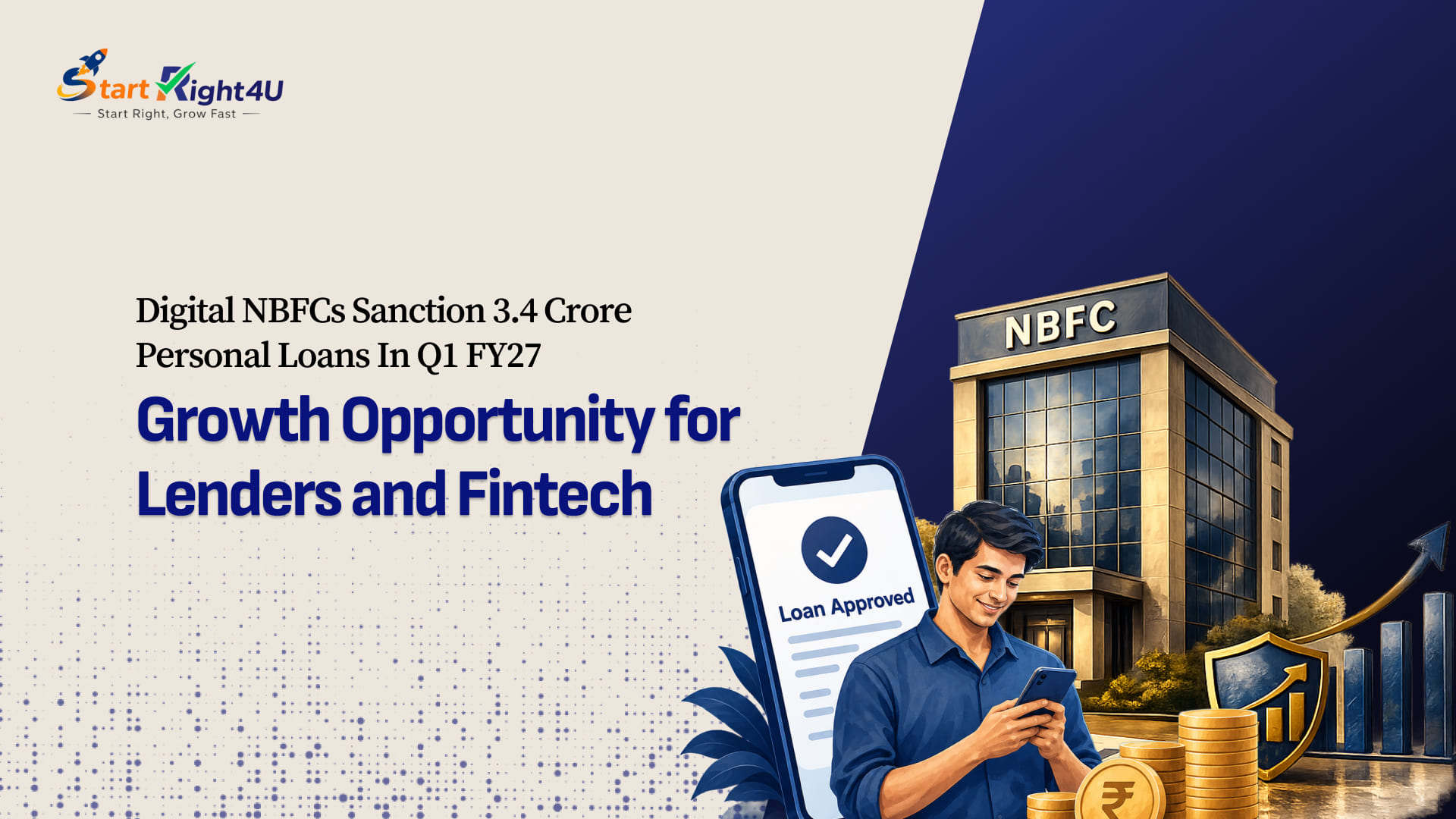
Digital NBFCs sanctioned 3.4 crore personal loans worth ₹64,656 crore between April and June 2026, according to the Fintech Association for Consumer Empowerment (FACE). The data, based on CRIF High Mark records covering more than 110 digital NBFCs, shows how deeply digital lending has moved into India's personal loan market.
Digital lending NBFCs accounted for about 70% of personal loan sanction volume in Q1 FY27, although their share of sanction value was 22%. The average digital NBFC loan size was ₹18,802, compared with ₹70,025 for other NBFCs and ₹4.52 lakh for banks.
For existing lenders, the numbers provide useful benchmarks for portfolio growth, ticket size, borrower profile, and asset quality. For founders planning to start a digital lending business in India, the data provides useful insights into borrower segments, ticket sizes, and distribution opportunities, as well as the infrastructure and compliance requirements involved.
The Headline Numbers From Q1 FY27
Digital NBFCs sanctioned 3.4 crore personal loans worth ₹64,656 crore in Q1 FY27.
Digital lending NBFCs accounted for about 70% of personal loan sanction volume but only 22% of sanction value. This reflects their concentration in high-volume, smaller-ticket personal lending..
Across all lenders, 4.9 crore personal loans worth ₹2.99 lakh crore were sanctioned during the quarter.
Digital NBFC sanction value grew 50% year on year, while the average ticket size reached ₹18,802, up around 15% from FY26.
The average ticket size was ₹70,025 for other NBFCs and ₹4.52 lakh for banks.
This indicates that digital lending NBFCs remain concentrated in high-volume, small-ticket personal lending, while banks operate at substantially higher average ticket sizes.
Loans below ₹25,000 contributed 27% of digital NBFC sanction value. Loans between ₹25,000 and ₹50,000 contributed another 12%. At the same time, loans above ₹50,000 accounted for roughly 59% of sanction value, showing that the segment is gradually moving towards larger ticket sizes as well.
Who Is Borrowing and Why It Matters
Borrowers under 35 accounted for 58% of sanction value.
40% of sanction value came from Tier III cities and beyond.
Women accounted for 18% of sanction value, a figure FACE flagged as roughly in line with other lenders and as a sign of a continuing gap in women's access to formal credit.
Around 60% of sanction value went to loans above ₹50,000, to borrowers with at least five years of credit bureau history, and to customers rated mid to low risk.
A digital lending app targeting only large cities may miss a significant part of the addressable market. Distribution, customer communication, language support, credit assessment, and collections need to work across smaller cities as well.
The data also shows that digital lending NBFC is not limited to customers with very short credit histories. This suggests that digital lenders are gradually moving beyond a pure small-ticket, high-risk lending model.
What This Growth Means If You Want to Start a Digital Lending NBFC
According to the industry data, the digital NBFC portfolio stood at ₹1.54 lakh crore and was growing at 28% year on year; it is not a market in decline. It is still open to new entrants, but the entry bar has risen. RBI scrutiny on data privacy, recovery practices, and loan app conduct has tightened since 2022, and FACE itself now operates as an RBI-recognised self-regulatory organisation for fintech lenders. Set up your compliance function before you write your first loan, not after.
Capital and Registration Requirements
An NBFC-ICC, the structure most digital personal loan businesses use, needs ₹10 crore in net owned funds.
Registration with the RBI typically takes 6 to 14 months from incorporation to your Certificate of Registration, depending on your application quality and the current review queue.
You need a clean promoter background, a board with the required independent directors, and a documented business plan before you file.
Compliance Priorities Before You Launch
Build your digital lending app on RBI's Digital Lending Directions from day one. Collect only the data your loan process needs, and do not access contacts, call logs or media on a borrower's phone.
Store all borrower data on servers located in India.
Register every lending app, including any white-labelled apps run by partners, on the RBI's CIMS portal.
Set a default loss guarantee structure and fee disclosure process that matches RBI's First Loss Default Guarantee rules if you plan to use a co-lending or partnership model.
Draft a breach response plan that meets both the six-hour CERT-In reporting window and the DPDP Act's 72-hour detailed report requirement.
If you already operate a digital lending NBFC, the compliance list above is your audit checklist, not a one-time setup task. RBI inspections and borrower complaints to the Data Protection Board both increase when sanction volumes rise this fast.
Risk Signals to Track Every Quarter
Track your 90+ DPD ratio against the industry's 1.4%. A ratio meaningfully above that line means your underwriting needs review.
Watch average ticket size growth against your approval rate. Rising ticket size with a stable or falling approval rate usually means you are lending more to existing good customers rather than expanding into new, riskier ones.
Compare your Tier III and beyond share against the industry's 40%. If you lag far behind, your distribution and language support likely need work. If you are far ahead, check that your collections infrastructure covers those geographies.
Review your women borrower share against the industry's 18%. A lender that closes this gap builds a differentiated, defensible customer base.
What This Means for Existing NBFCs
Existing NBFCs already operating in personal lending can use the Q1 FY27 data to review their product and distribution strategy.
The first area is ticket size. With digital NBFCs averaging ₹18,802 per loan, small-ticket personal credit remains central to the digital model. However, the increasing contribution from loans above ₹50,000 indicates that lenders are also expanding within higher ticket segments.
The second area is geography. With 40% of sanction value going to Tier III cities and beyond, lenders need distribution and collection models that can operate outside major metros.
The third area is customer segmentation. A young borrower base requires strong digital onboarding, clear disclosures, efficient customer support and responsible credit assessment. Product design should reflect the target borrower's income profile, credit history, ticket size and digital behaviour rather than simply replicating a traditional personal loan process inside an app.
The fourth area is compliance. Digital distribution does not transfer regulatory responsibility away from the NBFC. RBI's digital lending framework places obligations on regulated entities even when they use Lending Service Providers or Digital Lending Apps.
What Existing NBFCs Should Review
Review whether your current ticket sizes match demand in the small-ticket segment.
Assess your exposure to Tier III cities and smaller towns.
Review underwriting performance across borrower vintages.
Check whether your digital lending partners and LSPs meet current RBI requirements.
Review collection processes as your digital portfolio expands.
Compare your 90+ DPD, approval rate, ticket size, and collection efficiency with your internal historical performance.
Review the economics of your digital portfolio, including acquisition cost, cost of funds, credit losses, collection costs and contribution margin.
Review whether your technology stack provides adequate audit trails, data controls and monitoring across LSPs, DLAs and other service providers.
Why Digital NBFCs Are Gaining Share in Personal Lending
Three factors explain the sustained growth in this data:
Speed: Digital processes can support faster application, underwriting, and disbursal for eligible borrowers, while a bank personal loan often takes days.
Ticket size fit: Banks and traditional NBFCs are not built to profitably underwrite a ₹15,000 to ₹20,000 loan at scale. Digital NBFCs are.
Distribution reach: Digital distribution can allow lenders to reach borrowers beyond major cities without relying entirely on a traditional branch network
The Q1 FY27 data shows continued demand for digital personal lending, while regulatory oversight around data, recovery practices, and partner accountability remains important.
What Founders Need to Know Before Starting a Digital Lending NBFC Business
The Q1 FY27 data highlights the scale of the opportunity, but market demand is only one part of the equation. A digital lending business also needs the right regulatory structure, capital, technology, underwriting, and compliance framework.
If you want to start a digital lending business in India, the first decision is to determine the business structure. A founder may consider an NBFC-led lending model, a fintech partnership with an existing regulated entity, or an LSP-based model where the regulated lender remains responsible for the lending activity.
If the business itself intends to lend from its balance sheet, NBFC registration and RBI regulatory requirements become central to the structure.
For an NBFC-ICC that has or intends to have customer interface and access to public funds, RBI's regulatory framework provides for a ₹10 crore Net Owned Fund requirement. The RBI's handbook also distinguishes the requirements applicable to different NBFC categories.
The structure should therefore be finalised before investing heavily in the app, marketing and customer acquisition.
Digital Lending Business Models for New Entrants
NBFC-led model: The company lends from its own balance sheet and takes responsibility for the lending and regulatory framework.
Fintech and NBFC partnership: A fintech can provide technology, customer acquisition or other permitted services while the regulated NBFC undertakes the lending activity and retains the responsibilities assigned to it under RBI regulations.
LSP model: An LSP works with a regulated lender for functions such as sourcing, onboarding or servicing. The regulated entity remains responsible for its regulatory obligations.
Key Takeaways
Digital NBFCs accounted for about 70% of personal loan sanction volume but 22% of sanction value in Q1 FY27, reflecting their concentration in smaller-ticket lending
The ₹1.54 lakh crore outstanding portfolio is growing at 28% a year with stable asset quality at a 1.4% 90+ DPD ratio.
Borrowers are young and increasingly non-metro. Build your product and compliance stack around that reality.
Entry into this market still requires ₹10 crore in net owned funds and 6 to 14 months for RBI registration, plus a compliance-first approach to data privacy and cybersecurity rules.
Start Your Digital Lending Business With the Right Structure
The growth in digital personal lending is creating opportunities for existing NBFCs, fintech companies, and new financial services founders. But starting a digital lending business is not simply about building an app and acquiring customers.
You need the right NBFC structure, RBI registration strategy, lending model, technology framework, risk controls, and compliance processes before you scale.
StartRight4U helps businesses with NBFC registration, digital lending setup, RBI compliance, lending structures, and regulatory advisory. If you are planning to start a digital lending business, launch a digital lending NBFC, or expand an existing NBFC into digital personal lending, review your proposed structure and business model before launch.