RBI
NBFC Collaboration Business Models: Lead-Based, Co-Lending & Fintech-Led
India's credit ecosystem has quietly gone through one of its biggest structural shifts in the last five years, and it has very little to do with new products or flashy interest rates. It has everything to do with who is originating the loan, who is funding it, and who is servicing it once it's disbursed. This shift is what the industry now broadly calls NBFC Collaboration Business Models — a term that covers the different ways in which Non-Banking Financial Companies partner with banks, fintech platforms, and digital lenders to source customers, share capital, and manage risk. If you run an NBFC, are exploring a fintech partnership, or are simply trying to understand why your loan got approved by three different logos on the same sanction letter, this article breaks down exactly how these arrangements work.
What is NBFC Collaboration and Why Has it Become India's Fastest-Growing Lending Structure?
NBFC collaboration, at its core, is a formal or contractual arrangement where an NBFC works with another financial entity — a bank, a fintech company, or another NBFC — to expand its lending capability without expanding its own balance sheet at the same pace. India currently has thousands of registered NBFCs, but only a small fraction of them has loan books large enough to lend independently at scale. Most mid-size and small NBFCs are capital-constrained, which means they either can't raise enough deposits or their cost of borrowing is too high to compete with banks. At the same time, banks have surplus capital but lack the last-mile reach, digital agility, and risk appetite for underserved borrower segments. Fintech companies sit somewhere in between — they have technology, data, and distribution, but in most cases, they are not permitted to lend directly without a regulated partner.
This is exactly the gap that NBFC collaboration business models fill. Instead of each player trying to do everything on its own, they specialise: one brings capital, one brings the customer, and one brings the technology or underwriting layer. Banks and NBFCs share loan risks and profits, supported by fintech credit assessment tools for efficient risk management. The result is faster loan disbursal, wider geographic coverage, and access to credit for borrower segments that traditional banking channels have historically ignored, particularly in Tier-2 and Tier-3 India.
What are the Main Types of NBFC Collaboration Business Models?
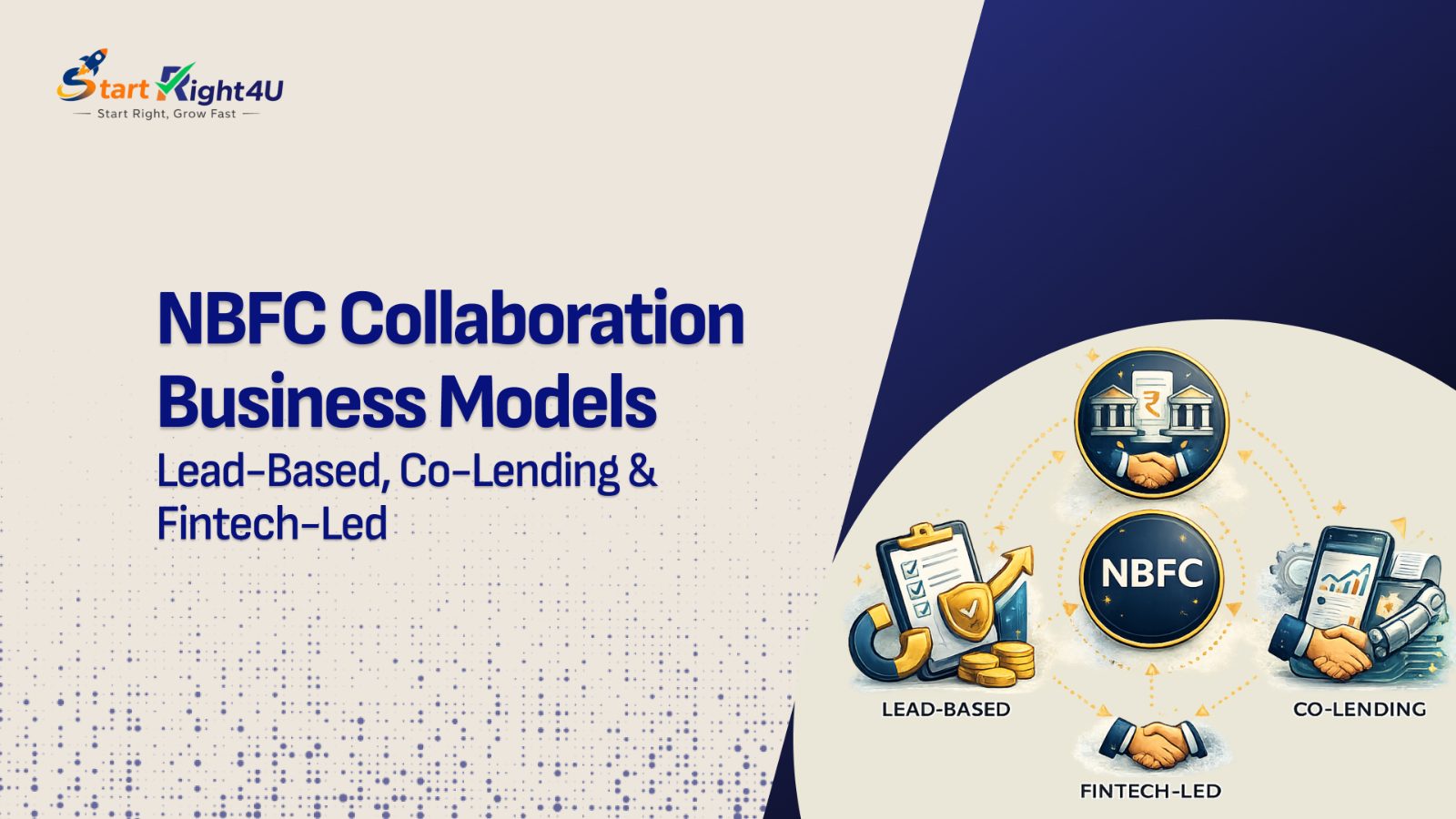
Broadly, NBFC collaboration business models fall into three recognisable structures, each with a different division of labour, risk-sharing pattern, and regulatory treatment. While hybrid versions exist in the market, understanding these three in their pure form makes it much easier to evaluate any real-world partnership you come across.
What Is the Lead-Based NBFC Collaboration Model?
The lead-based model is the simplest and oldest of the three. Here, a fintech company or a digital platform acts purely as a lead generator. It uses its app, website, or marketing reach to attract prospective borrowers, collects basic information, and passes these qualified leads on to the NBFC. The NBFC then takes over completely — it conducts its own credit assessment, disburses the loan from its own books, and manages collections and servicing end to end. The fintech's involvement typically ends once the lead converts, and its compensation is a one-time or recurring referral fee rather than a share of the loan's interest income.
Because the NBFC retains full ownership of underwriting and the loan asset, this model carries the least regulatory complexity. It doesn't require a co-lending agreement or joint sanction letters, and the NBFC's balance sheet exposure is unaffected by the fintech's involvement. The trade-off is scale: since the NBFC still funds every loan from its own capital, its growth is capped by its own liquidity and net owned funds. Many new-age NBFCs use this model as a first step before graduating into deeper co-lending or FLDG-backed arrangements once they've built trust with a fintech partner.
How Does the Co-Lending Model Work Between NBFCs and Banks?
Co-lending is a step further in integration and is currently the most regulated and widely tracked model, governed by RBI's co-lending guidelines. In this structure, both the bank and the NBFC fund the same loan simultaneously, in a pre-agreed ratio, most commonly with the bank contributing around 80% of the loan amount and the NBFC retaining the remaining 20% on its own books. The NBFC is typically responsible for lead generation, customer contact, initial eligibility screening, and credit underwriting, while the bank provides funds and conducts final verification before disbursement.
There are two recognised variants in practice. Under what the industry calls CLM1, borrowers were historically onboarded with both lending entities at once, which created operational friction. This was later streamlined through CLM2, introduced in 2020, which allows customers to be onboarded just once on the NBFC's front-end platform, with the bank contributing up to 80% of the lending capital behind the scenes. This single-onboarding structure is now the industry standard because it gives borrowers a seamless experience — they deal with one lender-facing brand while two institutions quietly share the funding and the risk.
In this arrangement, the bank usually acts as the lead lender providing most of the funds, while the NBFC or fintech platform functions as the originating lender that finds the borrower and manages the front-end process, and also typically serves as the servicing partner handling EMI collection and default management. Profits, losses, and non-performing assets are shared proportionally between the two institutions as per the co-lending agreement. This model has grown rapidly because it solves a genuine problem for both sides: banks get priority-sector and MSME lending exposure without building distribution from scratch, and NBFCs get access to low-cost bank capital without diluting their own balance sheet capacity. According to industry data, India's co-lending portfolio crossed ₹1.3 lakh crore in 2025, growing 45% year-on-year, largely led by digital-first NBFC partnerships, which shows just how central this model has become to mainstream credit delivery in the country.
How Does the Fintech-Led NBFC Collaboration Model Work?
The fintech-led model is the most technology-intensive of the three and typically involves a First Loss Default Guarantee, commonly referred to as FLDG. Here, the fintech company effectively behaves like the lender in the eyes of the customer, even though the NBFC holds the actual loan on its books, since fintechs without an NBFC or banking licence cannot lend directly under RBI regulation.
Under this structure, the fintech sources the leads, runs its own risk models and credit scoring algorithms, and often manages the customer relationship and app experience entirely. To protect the NBFC against default risk on loans it didn't originate through traditional means, the fintech provides a guarantee — usually a fixed percentage of the loan pool, deposited upfront with a fund manager or held as a fixed deposit — that covers early losses if borrowers default. The NBFC opens a dedicated account for this arrangement, disburses the loan, and processes repayments, while the fintech frequently handles collections on the NBFC's behalf as well. In this, fintechs prioritise user experience and data analytics, handling lead generation, credit scoring, and monitoring through AI-driven models, while NBFCs earn from interest margins and fintechs earn from origination and servicing fees.
This model has enabled some of India's fastest-growing digital lending apps to scale rapidly without ever holding an NBFC licence themselves. It is particularly effective for small-ticket, high-volume products like buy-now-pay-later, instant personal loans, and merchant cash advances, where speed and app-based convenience matter more to the borrower than which entity is technically the lender of record. However, because FLDG arrangements involve risk transfer outside the regulated banking system, RBI has tightened disclosure and capping norms around them, making legal structuring and compliance documentation critical for any NBFC entering this space.
How do the Three NBFC Collaboration Business Models Compare?
Choosing between lead-based, co-lending, and fintech-led structures depends on what an NBFC actually needs — capital, distribution, technology, or all three. The table below summarises how the three models differ across the factors that matter most in practice.
Parameter | Lead-Based Model | Co-Lending Model | Fintech-Led (FLDG) Model |
Who funds the loan | NBFC funds 100% | Bank and NBFC jointly (typically 80:20) | NBFC funds, backed by fintech's FLDG cover |
Who generates leads | Fintech/partner platform | NBFC, sometimes with digital sourcing support | Fintech, using its own app and data models |
Underwriting ownership | NBFC | Jointly agreed, often NBFC-led with bank verification | Fintech's risk models, NBFC's final sanction |
Risk sharing | None shared; NBFC bears full risk | Proportional, as per co-lending agreement | Fintech absorbs early losses via FLDG deposit |
Regulatory complexity | Low | High (RBI co-lending guidelines apply) | Moderate to high (FLDG disclosure norms apply) |
Typical use case | Referral partnerships, early-stage collaborations | MSME, priority sector, secured retail loans | Small-ticket digital loans, BNPL, instant credit |
Growth ceiling for NBFC | Limited by NBFC's own capital | High, since bank capital funds most of the loan | High, but dependent on fintech's guarantee strength |
How Should an NBFC Choose the Right Collaboration Model?
There is no universally "best" model among the three — the right choice depends on where an NBFC stands today and where it wants to be in the next few years. An NBFC that is new to digital partnerships and wants to test a fintech relationship with minimal regulatory exposure will usually start with a lead-based arrangement, since it requires the least documentation and carries no shared-risk liability. An NBFC that already has a healthy net owned fund position and wants to scale its loan book significantly, particularly in MSME or secured lending categories, is far better served by co-lending, because it unlocks bank-grade capital at a lower cost of funds than the NBFC could raise on its own. And an NBFC that wants to move fast into digital-first, high-volume, small-ticket lending — where speed of disbursal and app experience decide customer acquisition — will find the fintech-led FLDG model more suitable, provided it has the legal and compliance bandwidth to manage FLDG caps, escrow structuring, and RBI reporting correctly.
What ties all three models together is documentation. Every collaboration, regardless of type, needs a legally sound agreement covering revenue sharing, data protection, grievance redressal, and default handling, along with ongoing compliance reporting to keep the arrangement audit-ready. This is often the part where NBFCs, especially smaller and mid-size ones, run into trouble — not because the business model is flawed, but because the underlying legal and regulatory structuring wasn't built to survive scrutiny.
Getting the Structuring Right
This is where a lot of NBFC collaboration business models quietly succeed or fail — not in the pitch deck, but in the fine print. Drafting a co-lending or FLDG agreement that actually holds up under RBI's evolving guidelines, setting up compliant escrow and fund-flow structures, and getting the revenue-sharing and NPA-sharing clauses right takes a fair bit of regulatory and legal groundwork. At StartRight4U, this is the kind of work our team spends a lot of time on — helping NBFCs and fintech companies think through which collaboration model actually fits their capital position and growth stage, structuring the agreements and compliance documentation around it, and making sure the partnership is built to last rather than just to launch. If you're evaluating a lead-based, co-lending, or fintech-led partnership for your NBFC, it's usually worth having that structuring conversation early, before the agreement is signed rather than after.