
RBI
RE (Regulated Entity) and LSP (Lending Service Provider) Outsourcing Compliance
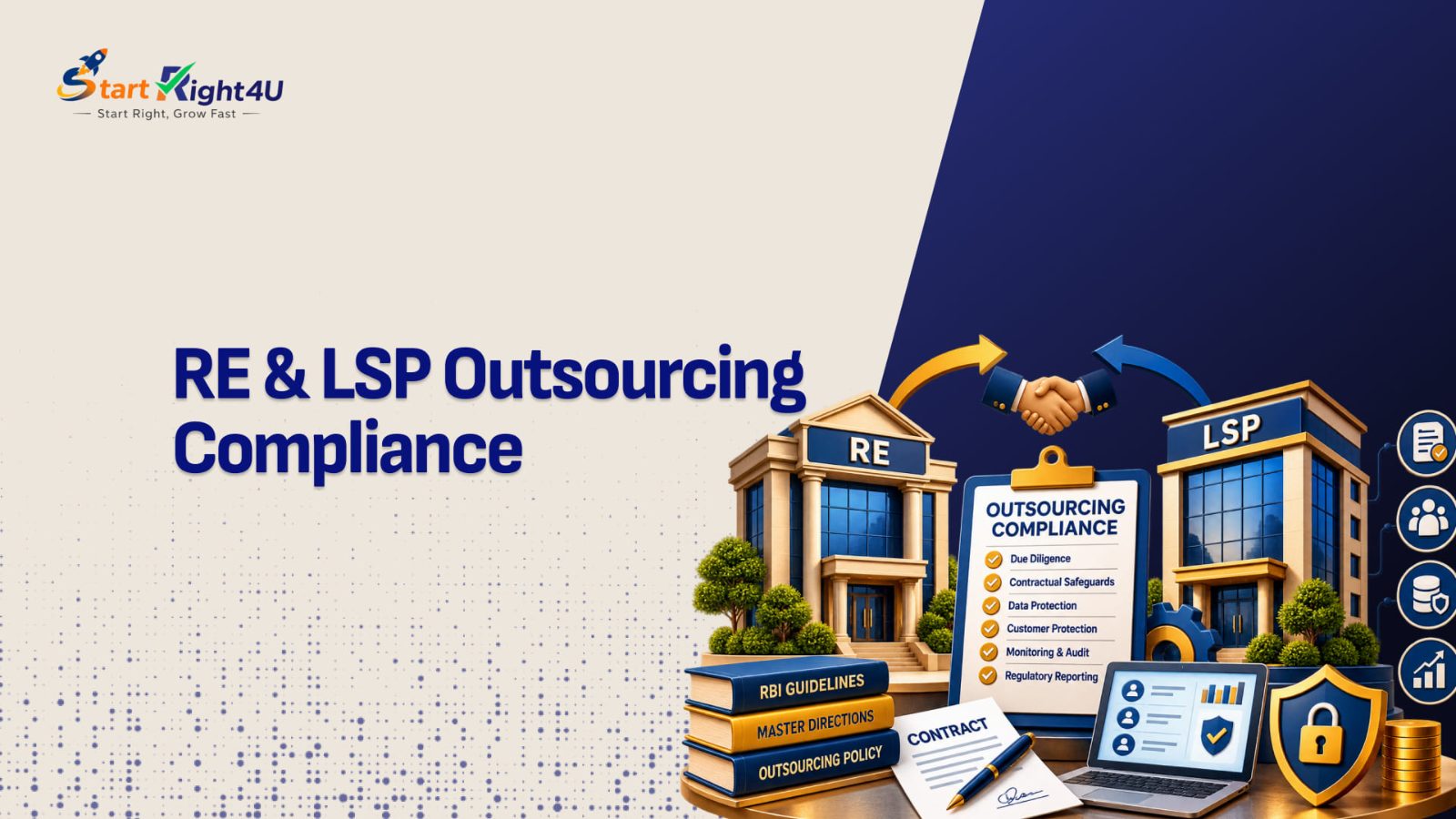
RE (Regulated Entity) and LSP (Lending Service Provider) outsourcing compliance has become an important part of running a digital lending business in India. Banks, NBFCs and other entities regulated by the Reserve Bank of India (RBI) increasingly work with technology companies, fintech platforms and other service providers for customer acquisition, underwriting support, loan servicing, monitoring and recovery. However, outsourcing does not transfer the regulatory responsibility from the lender to the service provider.
The RBI expects a Regulated Entity (RE) to remain responsible for the activities performed through an LSP. This means an RE cannot simply appoint a fintech company, sign an outsourcing agreement and leave the compliance work to it. The lender must conduct due diligence, establish appropriate contractual controls, monitor the LSP, protect borrower data, maintain grievance redressal and ensure that the digital lending journey follows applicable RBI requirements.
The RE and LSP outsourcing compliance framework is therefore designed to create a clear line of responsibility between the regulated lender and the organisation providing outsourced lending services. StartRight4U can assist banks, NBFCs, fintech companies and lending platforms in reviewing their RE-LSP arrangements, identifying compliance gaps and preparing the required documentation and controls.
What is RE (Regulated Entity) and LSP (Lending Service Provider) Outsourcing Compliance?
Before understanding compliance, it is important to understand the two parties involved.
1. A Regulated Entity (RE) is an entity regulated by RBI and covered by the applicable digital lending framework. Depending on the regulatory framework, this can include commercial banks, cooperative banks, NBFCs including housing finance companies and All-India Financial Institutions.
2. An Lending Service Provider (LSP) is an agent engaged by an RE to perform one or more digital lending functions or parts of those functions. These functions may include customer acquisition, services incidental to underwriting and pricing, servicing, monitoring or recovery of a specific loan or loan portfolio.
In simple terms, the RE is the regulated lender, while the LSP is the service provider supporting the lender's digital lending operations. The relationship may appear operationally simple, but it creates several regulatory responsibilities. The RE needs to ensure that the LSP acts within the agreed scope, follows applicable regulatory requirements and does not compromise borrower protection.
The RBI's Digital Lending Directions, 2025 specifically require digital lending involving an LSP to operate under a contractual arrangement that clearly sets out the respective roles, rights and obligations of the RE and LSP.
Why is RE and LSP Outsourcing Compliance Important?
Digital lending can involve several parties at different stages of the lending process. A borrower may interact with an application or website operated by an LSP, while the actual loan is provided by an NBFC or bank.
This arrangement can create questions such as:
Who is responsible for the borrower?
Who controls the loan?
Who collects and processes personal information?
Who handles complaints?
Who is responsible for recovery practices?
Who monitors the LSP?
How are customer payments routed?
What happens if the LSP violates an RBI requirement?
The answer cannot simply be that the LSP is responsible because it performed the activity. RBI has repeatedly maintained the principle that outsourcing does not reduce the obligations of the regulated entity. The earlier digital lending framework expressly stated that RE-LSP/DLA outsourcing arrangements do not diminish the RE's obligations, and the 2025 Directions continue the same regulatory approach. Therefore, proper RE and LSP outsourcing compliance helps the lender maintain control over outsourced activities while protecting borrowers and reducing operational, regulatory, data and reputational risks.
Current RBI Framework for RE-LSP Arrangements
The regulatory position has evolved over the last few years.
1. RBI's 2020 instructions addressed loans sourced by banks and NBFCs through digital lending platforms and stressed compliance with fair-practice and outsourcing requirements. In 2022, RBI issued detailed Digital Lending Guidelines covering LSPs, digital lending apps, borrower protection, data collection and fund flows. The 2025 Digital Lending Directions subsequently consolidated and replaced the earlier digital lending framework.
2. For businesses today, compliance should therefore be checked against the RBI (Digital Lending) Directions, 2025, along with other applicable RBI directions relating to outsourcing, KYC, fair practices, information technology, customer protection, credit information and grievance redressal.
3. This distinction matters because simply following an old 2022 checklist may not be sufficient for a current RE-LSP arrangement.
Who Needs RE and LSP Outsourcing Compliance?
The requirement can become relevant wherever a regulated lender uses an LSP for digital lending functions.
Typical businesses and arrangements include:
Entity/Business | Relevance |
Banks | RE-LSP arrangements for digital lending |
NBFCs | Fintech and LSP-based lending operations |
Housing Finance Companies | Digital sourcing and servicing arrangements |
Fintech platforms | May operate as LSPs for regulated lenders |
Digital lending applications | May be operated by REs or their LSPs |
Technology-enabled lending businesses | May require review of outsourcing structure |
Functions an LSP May Perform
An LSP can support an RE at different stages of the digital lending process. Some common functions include:
Customer acquisition and lead generation.
Digital application processing.
Services incidental to underwriting.
Pricing-related support.
Loan servicing.
Customer communication.
Loan monitoring.
Recovery-related activities.
Technology and platform support connected with digital lending.
Key Requirements Under RE-LSP Outsourcing Compliance
The following are the requirements under RE-LSP Outsourcing Compliance:
1. Written Agreement Between RE and LSP
One of the basic requirements is a proper contractual arrangement between the RE and LSP. The agreement should clearly explain:
Scope of services.
Roles and responsibilities.
Regulatory obligations.
Data protection requirements.
Customer protection responsibilities.
Grievance handling.
Audit and inspection rights.
Reporting requirements.
Information-security obligations.
Business continuity arrangements.
Termination and exit provisions.
A vague agreement can create problems later because it becomes difficult to determine whether the LSP has acted within its authority. The RBI's 2025 Directions specifically require the RE-LSP relationship to be governed by a contract defining the respective roles, rights and obligations.
2. Enhanced Due Diligence of the LSP
An RE should not appoint an LSP merely because the technology or commercial proposal appears attractive. Before entering into the arrangement, the RE is expected to conduct enhanced due diligence.
This may cover:
Technical capabilities.
Data privacy policies.
Data storage systems.
Information-security controls.
Past conduct.
Borrower treatment.
Regulatory compliance history.
Financial and operational capability.
Business continuity arrangements.
Ability to meet contractual obligations.
3. Periodic Monitoring of the LSP
Compliance does not end after onboarding. An RE should periodically review whether the LSP is actually performing according to the contract and applicable regulatory requirements.
Monitoring can cover:
Customer complaints.
Service-level performance.
Data-security incidents.
Recovery practices.
Loan servicing.
Compliance deviations.
Customer communication.
Audit findings.
Regulatory changes.
Where deviations are identified, the RE should take appropriate corrective action. This ongoing monitoring is an important part of effective RE and LSP outsourcing compliance.
4. RE Remains Responsible for Outsourced Activities
This is one of the most important principles. An RE cannot defend a regulatory violation simply by saying that the activity was performed by an external fintech or LSP. RBI's outsourcing framework states that outsourcing should not diminish the obligations of the regulated entity or the responsibility of its Board and senior management. The service provider should operate with standards comparable to those expected if the activity were performed internally. Therefore, the RE should maintain adequate internal controls over outsourced activities.
Customer Protection in RE-LSP Arrangements
Digital lending involves sensitive financial decisions and personal information. Customer protection is consequently a major component of compliance. The lending journey should be designed so that the borrower can understand:
Who the actual lender is.
What the loan costs.
What fees apply.
What the repayment obligations are.
How complaints can be raised.
How personal information will be used.
Who is responsible for servicing the loan.
An LSP should not create confusion about whether it is itself the lender or is acting on behalf of an RE. Earlier RBI instructions also required digital lending platforms acting as agents to disclose the name of the bank or NBFC on whose behalf they were interacting with customers.
Loan Disbursal and Repayment Controls
Fund flows are another important area.
The RBI's digital lending framework requires loan servicing and repayment to flow directly between the borrower and the regulated entity rather than being routed through a third-party pass-through or pool account, subject to specified regulatory exceptions. Similarly, disbursement is generally required to go directly to the borrower's bank account, subject to permitted exceptions. This requirement is important because the LSP should not become an intermediary holding borrower or lender funds merely because it operates the technology platform. A compliance review should therefore examine the complete fund-flow structure rather than reviewing only the loan agreement.
Key Fact Statement and Cost Disclosure
Borrowers should receive clear information about the cost and major terms of the loan. The broader RBI lending framework requires transparency around loan pricing and costs, while digital lending requirements have placed particular emphasis on the Annual Percentage Rate (APR), applicable charges and borrower disclosures.
RBI's 2025 framework also strengthened the approach to multiple-lender digital lending arrangements by requiring greater visibility of available loan offers. RBI's 2025 Annual Report notes that LSPs working with multiple lenders are required to provide a digital view of available loan offers so borrowers can make an informed choice, with information such as the RE name, loan amount, APR and tenor. This is especially relevant for fintech platforms that connect borrowers with multiple lenders.
Multiple-Lender LSP Arrangements
A fintech platform may work with more than one bank or NBFC. Such arrangements can create an additional layer of compliance risk because the LSP may have access to several loan products and may influence which lender or product a borrower sees. The current framework focuses on transparency and informed borrower choice.
An LSP operating with multiple REs should therefore review:
How lenders are displayed.
How loan offers are ranked.
Whether important information is clearly visible.
Whether borrowers can compare offers.
Whether the interface creates an unfair preference.
Whether dark patterns or manipulative design techniques are being used.
RBI's Annual Report specifically notes that the 2025 Directions addressed the presentation of loan offers by LSPs with multiple RE arrangements and prohibited the use of dark patterns to nudge borrowers towards a particular offer.
Data Collection and Privacy Compliance
Data is one of the most sensitive areas in digital lending. An LSP may interact with a borrower through an application and may therefore have access to identity information, financial information, contact details, transaction information or other personal data.
The RE should establish clear controls over:
What information is collected.
Why it is collected.
Whether collection is necessary.
How consent is obtained.
Where information is stored.
Who can access it.
How long it is retained.
How it is deleted or protected.
Whether the LSP can use it for another purpose.
The RBI's digital lending framework has emphasised need-based data collection, borrower consent, privacy policies and restrictions around storage and use of personal information. The RE should also consider applicable data-protection requirements and ensure that contractual arrangements with the LSP match the actual data flows of the platform.
Information Technology and Cybersecurity Controls
Many LSP arrangements are technology-driven. Therefore, financial-services outsourcing compliance can overlap with RBI's IT outsourcing requirements. RBI's Outsourcing of Information Technology Services Directions, 2023 require REs to assess outsourcing risks, conduct due diligence, maintain appropriate agreements, establish business continuity and disaster recovery arrangements, monitor outsourced activities and maintain an exit strategy. A compliance review should therefore consider whether the LSP's technology environment is capable of supporting the lender's regulatory obligations.
Important areas may include:
Access controls.
Authentication.
Data security.
Vulnerability management.
Incident management.
Backup.
Disaster recovery.
Business continuity.
System availability.
Audit trails.
Grievance Redressal Mechanism
A borrower should not lose access to a grievance mechanism simply because the lending journey involves an LSP. The RE should maintain a clear process through which customers can submit complaints and obtain a response.
The arrangement should establish:
Where the customer can complain.
Who receives the complaint.
Who investigates it.
How the LSP communicates with customers.
When the matter is escalated to the RE.
How unresolved complaints are handled.
Recovery and Collection Activities
Recovery is another area requiring careful oversight. If an LSP supports recovery, the RE should ensure that the persons acting on its behalf follow applicable RBI requirements and fair practices.
The lender should monitor:
Customer communication.
Recovery-agent conduct.
Calling practices.
Timing of communication.
Use of abusive or threatening language.
Documentation of recovery activity.
Customer complaints.
Escalation mechanisms.
Audit and Access Rights
A well-drafted RE-LSP agreement should allow the RE to monitor the outsourced activity properly. Depending on the arrangement, this can include rights relating to:
Records.
Transaction information.
Audit reports.
Security assessments.
System information.
Compliance records.
Customer complaints.
Regulatory information.
Business Continuity and Exit Management
What happens if the LSP suddenly stops providing services? This is often overlooked when businesses focus only on onboarding. An RE should consider whether it can continue critical lending operations if an LSP:
Becomes insolvent.
Suffers a major cyber incident.
Loses important technology.
Breaches the agreement.
Loses regulatory eligibility.
Becomes operationally unreliable.
A practical exit plan may cover transition of data, systems, customers, records and services to another provider or back to the RE. RBI's IT outsourcing framework specifically includes business continuity, disaster recovery and exit strategy as important components of IT outsourcing risk management.
Compliance Documentation for RE-LSP Arrangements
A strong compliance framework should be supported by proper documentation. Depending on the business model, documentation may include:
Document/Control | Purpose |
LSP Due Diligence Report | Assesses suitability of the LSP |
RE-LSP Agreement | Defines roles and obligations |
Data Protection Clauses | Controls borrower information |
Outsourcing Policy | Provides internal governance |
Risk Assessment | Identifies outsourcing risks |
Monitoring Framework | Tracks LSP performance |
Grievance Process | Handles borrower complaints |
Audit Framework | Supports periodic review |
Business Continuity Plan | Handles operational disruption |
Exit Plan | Supports orderly termination |
The exact document set should be customised to the RE, LSP and services involved.
Common Compliance Mistakes in RE-LSP Outsourcing
Several mistakes can create unnecessary regulatory exposure.
Outsourcing responsibility instead of activity
An RE can outsource a permitted activity, but it cannot outsource its regulatory responsibility.
Using a generic LSP agreement
A standard technology-service agreement may not adequately cover RBI-specific requirements.
No enhanced due diligence
Selecting an LSP only on commercial or technology capability without reviewing compliance and data-security controls can create risk.
Weak monitoring
An agreement is not enough. The RE should periodically check whether the LSP is following it.
Unclear borrower communication
Customers should know who the lender is and how the LSP fits into the lending process.
Improper fund flow
The RE should carefully verify whether loan disbursement and repayment arrangements comply with applicable RBI requirements.
Poor data controls
Excessive data collection, unclear consent, uncontrolled access and weak retention practices can create significant risks.
No exit strategy
The RE should know how critical services will continue if the LSP relationship ends.
RE-LSP Outsourcing Compliance Process
A practical compliance exercise can be divided into the following stages.
Step 1: Understand the Business Model
The first step is to understand the complete lending journey.
This includes identifying:
The actual lender.
The LSP.
Digital lending application.
Customer acquisition channel.
Underwriting process.
Loan servicing model.
Recovery model.
Data flow.
Fund flow.
Step 2: Identify Applicable RBI Requirements
The regulatory requirements applicable to the specific RE and outsourcing arrangement are identified.
This can include digital lending, outsourcing, IT outsourcing, KYC, fair practices, customer protection and other applicable directions.
Step 3: Review the LSP
The LSP is assessed from operational, technological, legal and compliance perspectives.
Step 4: Review the Contract
The RE-LSP agreement is checked to determine whether responsibilities, audit rights, data controls, customer protection and termination provisions are adequately covered.
Step 5: Review Customer Journey
The actual borrower journey is examined from application to repayment.
This is important because a contract may appear compliant while the application or website operates differently.
Step 6: Review Data and Technology
The data collected, consent mechanism, storage, access controls and technology arrangements are reviewed.
Step 7: Identify Gaps
Any deviations are documented and prioritised according to their potential impact.
Step 8: Implement Corrective Measures
Policies, agreements, processes, disclosures and operational controls are updated.
Step 9: Establish Monitoring
The RE should establish a continuing mechanism for reviewing the LSP.
Step 10: Maintain Compliance Records
Due diligence, reviews, audits, complaints and corrective actions should be properly documented.
Benefits of RE and LSP Outsourcing Compliance
A properly structured compliance framework can provide several practical benefits.
Better regulatory readiness
The RE has documented controls for managing its LSP relationship.
Reduced outsourcing risk
Due diligence and periodic monitoring can identify problems before they become major compliance issues.
Stronger customer protection
Clear disclosures, complaint handling and responsible lending practices create a better borrower experience.
Improved data governance
Defined data-access and security controls help reduce unnecessary exposure to sensitive borrower information.
Better contractual protection
A properly drafted agreement clarifies responsibilities and remedies if the LSP fails to meet its obligations.
Stronger operational resilience
Business continuity and exit planning reduce dependence on a single service provider.
Greater transparency
Clear lender identification and loan disclosures help borrowers understand who is actually providing the credit.
RE vs LSP: Understanding the Responsibility
Area | RE | LSP |
Regulatory responsibility | Primary responsibility | Must comply with agreed requirements |
Loan approval | Retained by RE where applicable | May provide permitted support |
Customer acquisition | May outsource | Can support |
Data handling | Must establish controls | Must follow controls |
Monitoring | Must monitor LSP | Must provide required information |
Grievance redressal | Must maintain effective mechanism | Supports resolution |
Recovery | Responsible for oversight | May perform permitted recovery activities |
Regulatory compliance | Ultimately responsible | Contractually and operationally responsible for its role |
This distinction is important. The LSP is not simply an independent vendor operating outside the lender's regulatory framework.
RE-LSP Compliance Checklist
Before entering into or renewing an RE-LSP arrangement, an RE can review the following basic checklist:
Is the LSP's role clearly defined?
Has enhanced due diligence been completed?
Is there a written agreement?
Are regulatory responsibilities clearly allocated?
Are borrower-protection controls documented?
Are data collection and consent practices reviewed?
Are fund flows compliant?
Is the lender clearly identified to borrowers?
Is the grievance mechanism effective?
Are recovery activities monitored?
Are audit and inspection rights available?
Is LSP performance periodically reviewed?
Are cybersecurity and IT risks assessed?
Is business continuity addressed?
Is there an exit strategy?
Are compliance records maintained?
Conclusion
RE and LSP outsourcing compliance is an essential part of responsible digital lending. The use of an LSP can make lending faster, more technology-driven, and easier to scale, but outsourcing does not remove the RE's regulatory responsibility. The RE must maintain appropriate control over the outsourced activity, conduct enhanced due diligence, enter into a clear contractual arrangement, monitor the LSP, protect borrower information, maintain grievance redressal, and ensure that customer-facing and fund-flow processes comply with applicable RBI requirements.
The regulatory framework has also moved beyond simply checking whether an outsourcing agreement exists. The current approach places greater emphasis on borrower protection, transparency, data governance, multiple-lender arrangements, technology risks and ongoing oversight. RBI's 2025 Digital Lending Directions consolidate the earlier digital lending framework and specifically address RE-LSP arrangements, enhanced due diligence and monitoring requirements. For banks, NBFCs, fintech platforms and other businesses involved in digital lending, compliance should therefore be treated as an ongoing process rather than a one-time documentation exercise.
StartRight4U can help you assess and strengthen your RE-LSP outsourcing framework, review the applicable compliance requirements, identify gaps and develop practical controls suited to your lending model. With the right structure in place, businesses can manage their outsourcing relationships more effectively while maintaining regulatory discipline and protecting borrower interests.